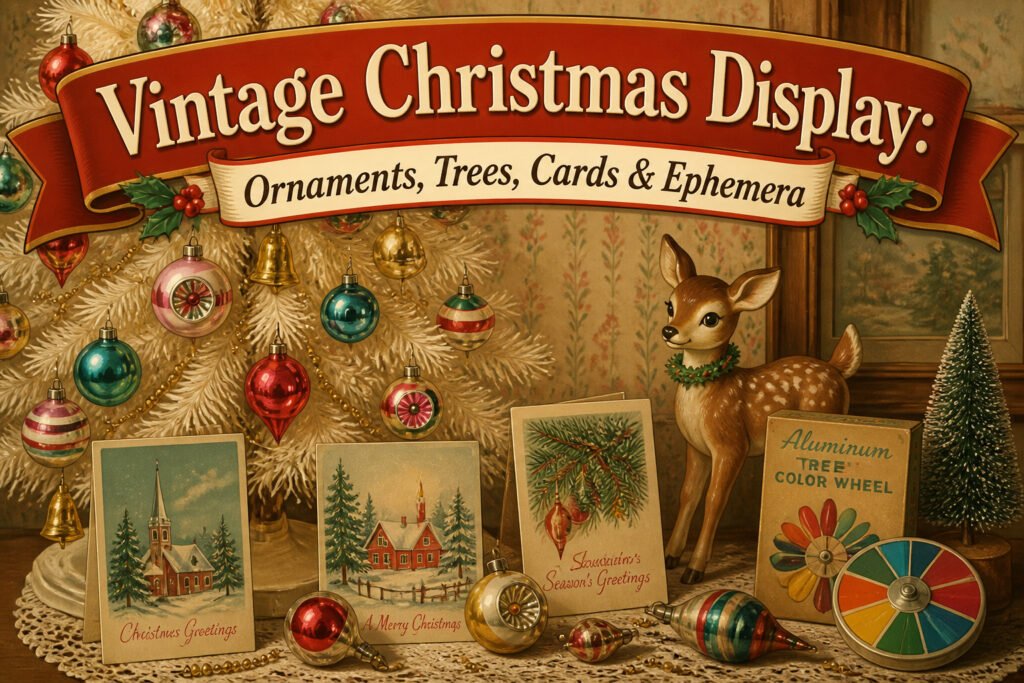
A vintage Christmas display is a curated arrangement of authentic holiday objects from the 1930s through the 1980s, built around period-true pieces rather than modern reproductions. The real cost is condition: flaking mica on a Shiny-Brite ornament or a cracked ceramic deer leg drops display value faster than the price suggests, so knowing what damage to accept separates a convincing scene from a cluttered shelf. A 14-inch goose-feather tree or a working 1950s color wheel for an aluminum tree proves the era in a way new stock never does.
Vintage Shiny-Brite Ornaments
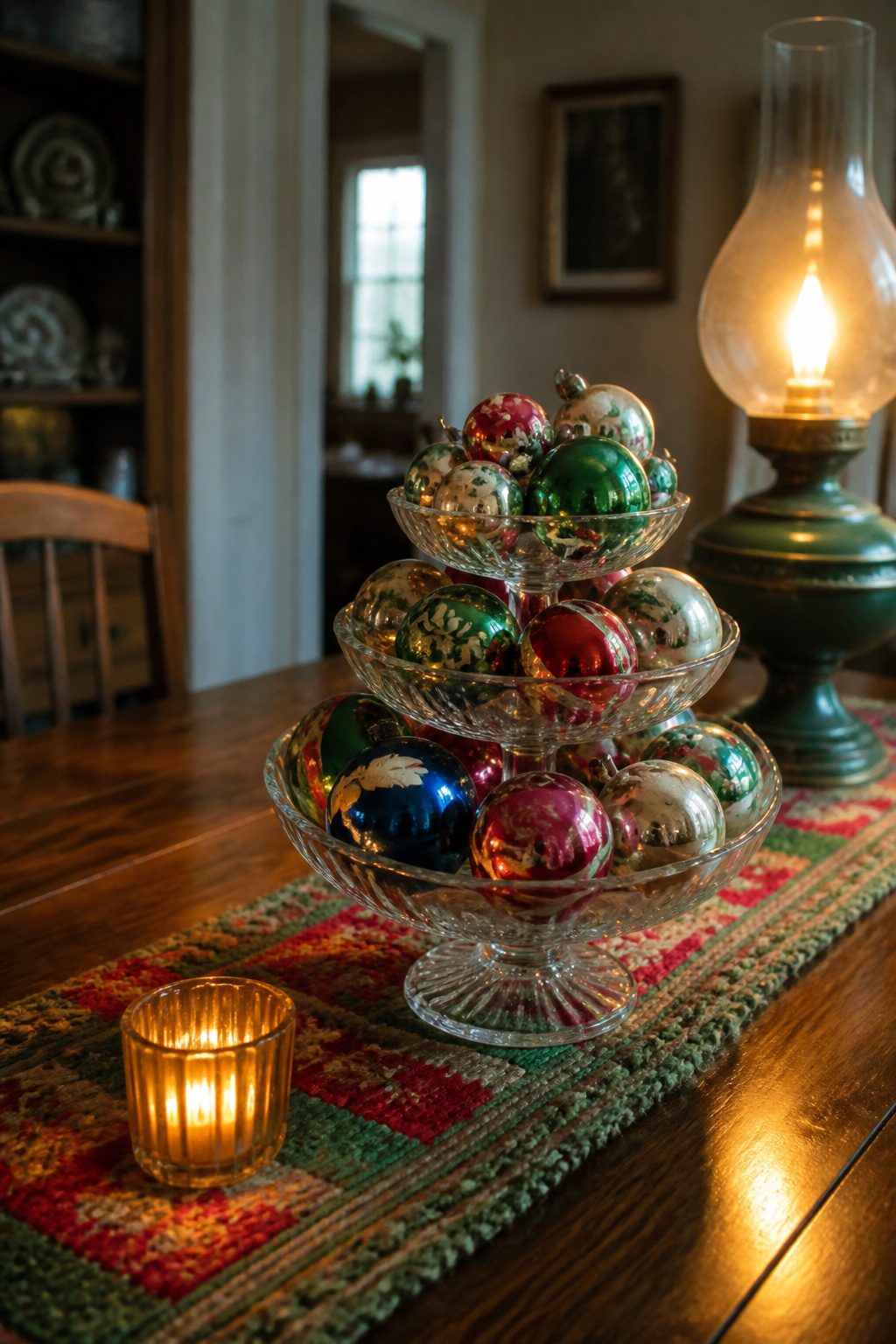
Painted glass ornaments from the 1930s through the 1960s anchor most vintage Christmas displays I see that actually feel period-true. Shiny-Brite ornaments dominate that category: manufactured in the United States across those decades, they were designed with thin glass walls and interior metallic lacquer that catches light differently than modern equivalents. The painted patterns matter for authentication. Stripes, mica snow caps, and indents with concentric rings indicate original production, while the color palette runs to saturated reds, greens, and blues alongside less common pinks and teals that now signal genuine age.
These work on the tree, but I prefer them as tabletop centerpieces where the paint detail stays visible. A tiered bowl groups them safely and lets the metallic interiors reflect each other; the arrangement reads as intentional rather than leftover. Condition varies sharply with pre-1960s pieces, and the glass is thinner than most people expect, so stacking them in a bowl requires care. I have passed on sets with flaking mica or worn caps because the display value drops faster than the price suggests.
Vintage Putz Houses
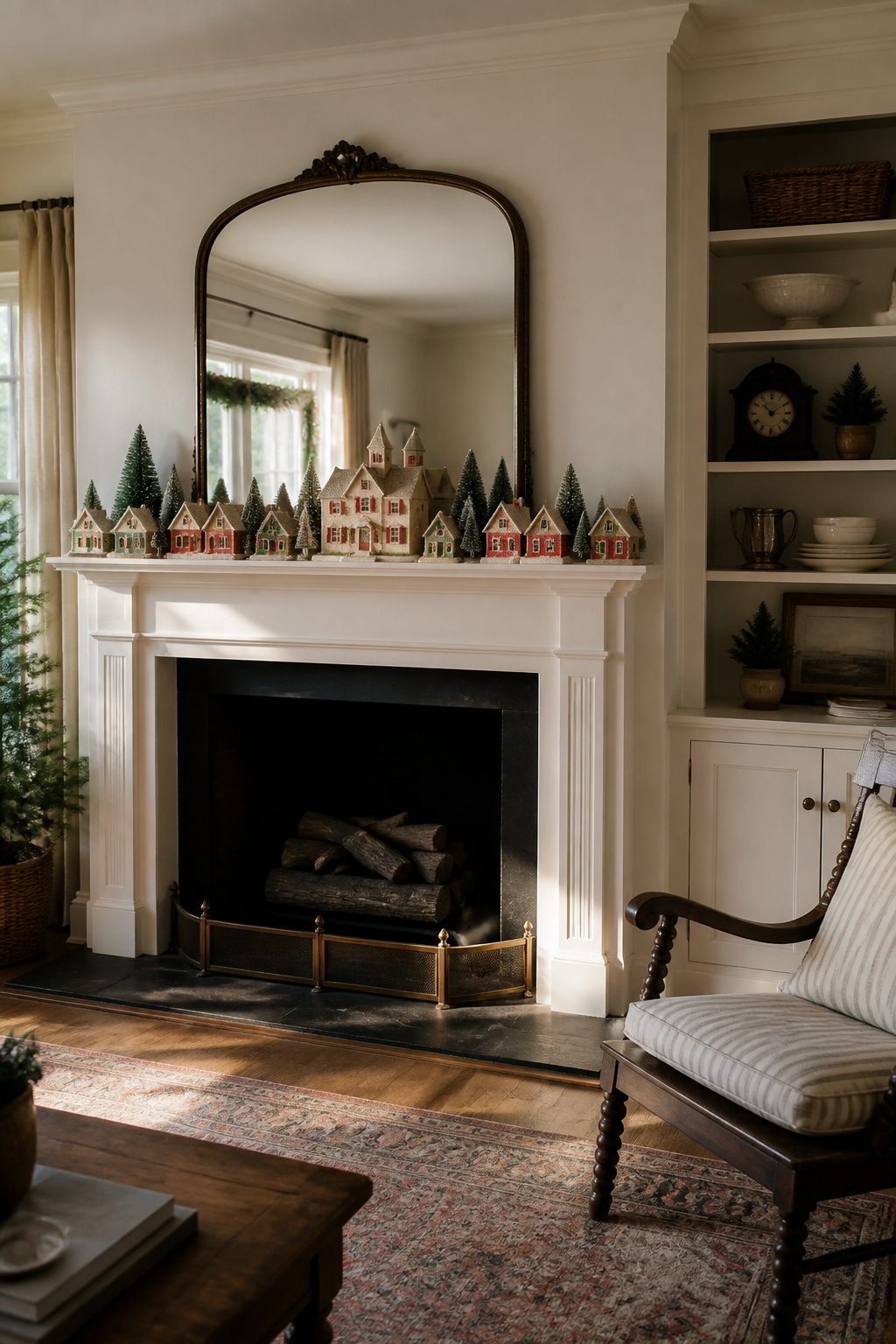
Brightly colored cardboard dwellings known as Putz houses trace back to Germany, where they first appeared as part of nativity scenes before migrating to American mantels in the early twentieth century. Most vintage examples stand just a few inches tall, small enough to cluster a dozen on a narrow shelf but large enough to read from across a room. The real charm comes from arrangement: a single house looks orphaned, but three or four staggered in depth with bottlebrush trees tucked between them builds a village that pulls the eye inward. Start the scene with one larger house slightly off-center, then fill toward the edges with smaller pieces so the grouping feels discovered rather than staged. I learned the hard way that symmetry kills the illusion; the best displays look like someone set them down quickly after dinner and left them there for weeks. A low table or mantel with a mirror behind it doubles the sense of distance without costing floor space, which matters when you are renting and the only display surface is the one that came with the fireplace.
Vintage Santa Figurines
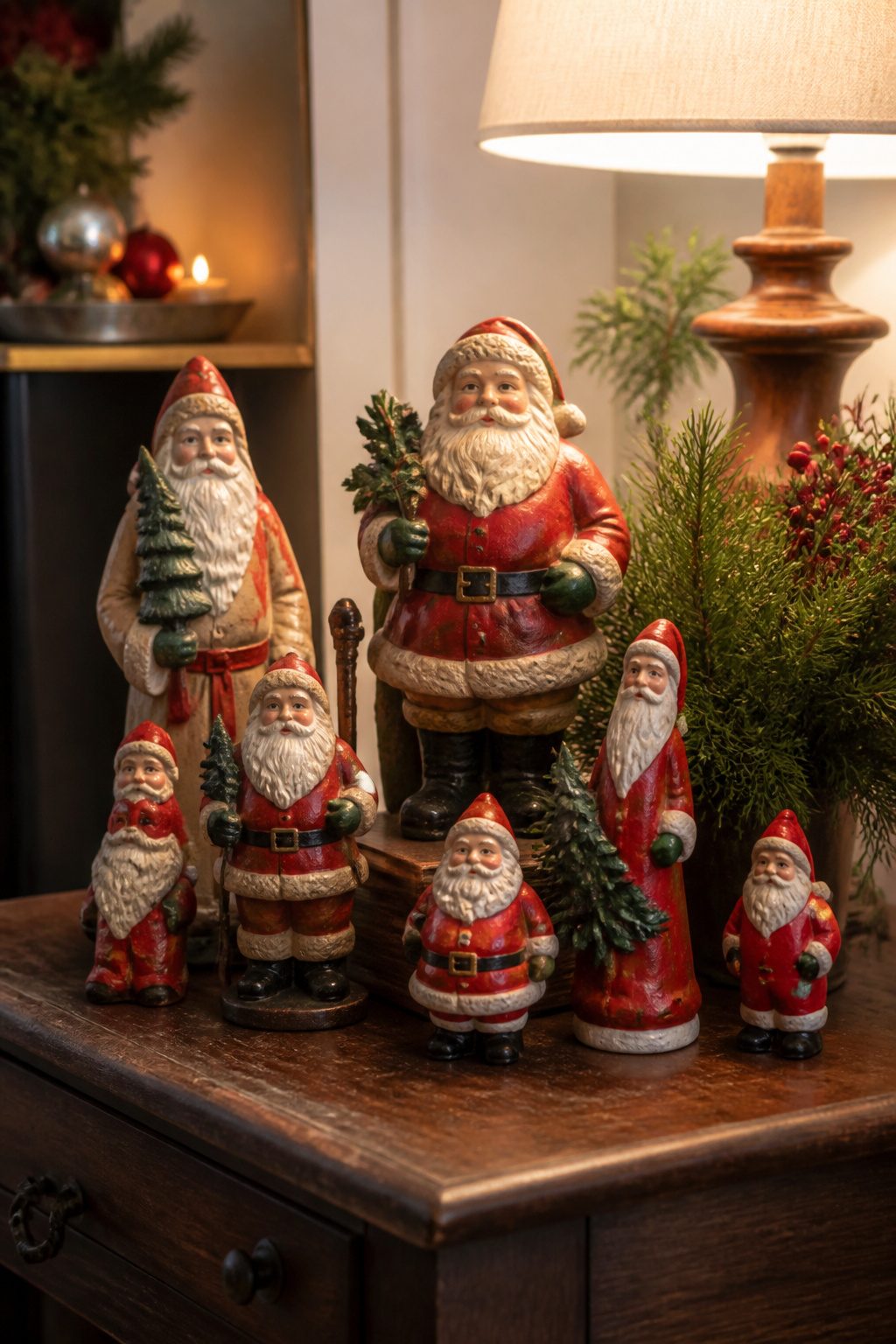
Vintage Santa figurines run from small tabletop pieces all the way up to a 62-inch tall outdoor figure that commands a front porch or entryway. That size jump matters for where you actually put them. A composition Santa a foot or two high fits on a mantel or bookshelf without drama; the porch-scale blow molds need floor space and a plan for weather.
Composition material shapes what you can do with them. The smaller classic figurines group well in clusters, which helps if condition is rough. Paint chips or a cracked base on one piece disappear when five or six stand together. A single large blow mold with fading or a split seam, though, reads as damaged from the street.
For renters especially, the smaller figurines win on flexibility. They move between rooms, layer into existing displays, and store in a bin when January hits. The big outdoor figures commit to a spot for the season and need storage space that most apartments do not have. Glow-up blow molds, vintage or new, have surged in popularity, but the vintage ones carry the patina that makes the display feel found rather than bought.
Vintage Aluminum Christmas Trees
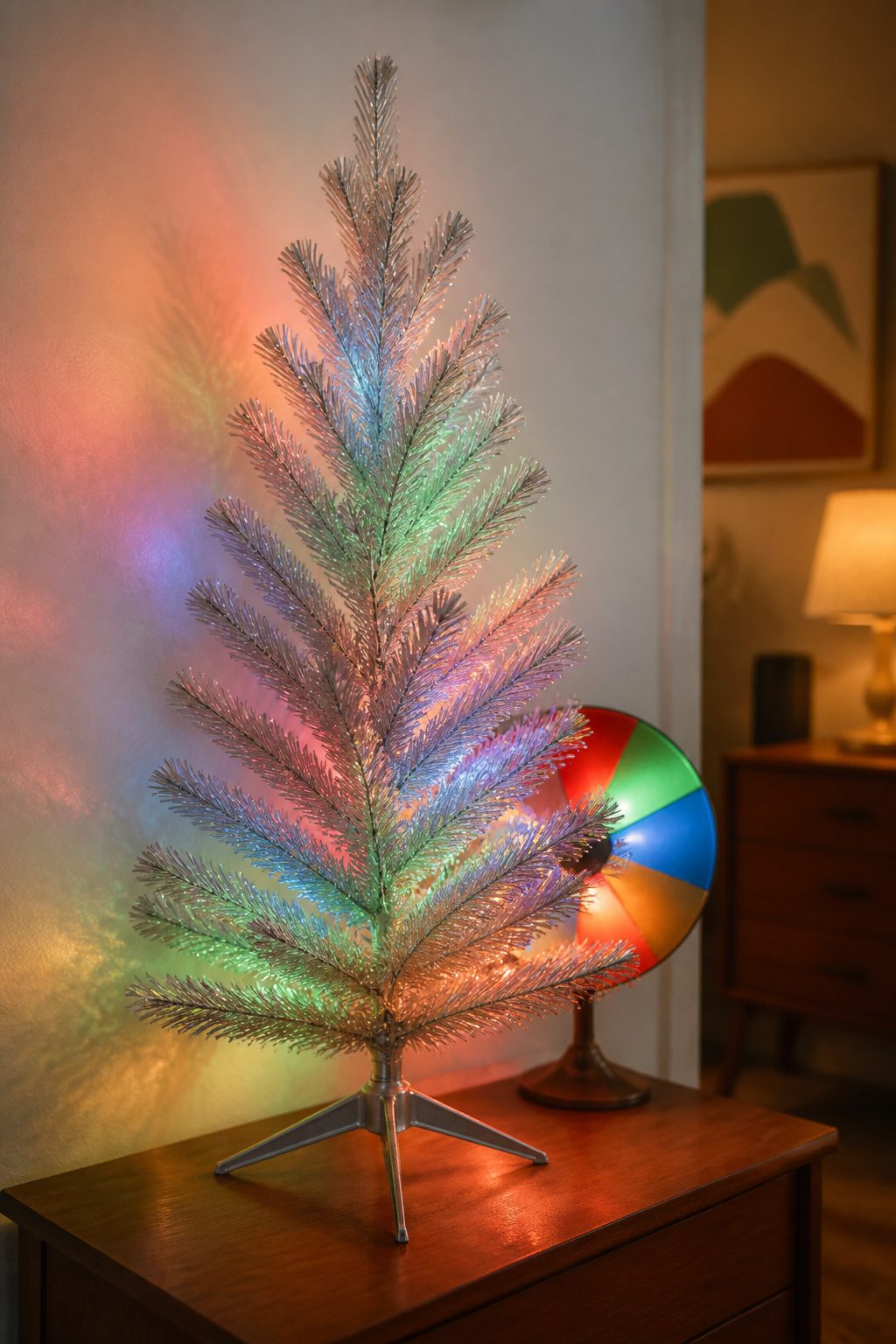
A three-foot aluminum tree fits where a seven-footer never could, and that compact size is half the reason these 1950s and 1960s originals still circulate at estate sales and flea markets. The branches are thin aluminum needles, usually in one metallic shade, and the whole thing sits on a rotating base that turns slowly beneath a color wheel. The wheel is the display: a lamp with a spinning gel disc throws red, then blue, then green across the needles, and the tree becomes something closer to a living room sculpture than to anything you would hang ornaments on.
Most collectors leave the branches bare. A single ornament would only stop the light and break the effect. The vintage color wheels themselves are the piece to hunt for, since reproduction motors tend to run fast and loud; an original spins at the right sleepy pace and stays quiet enough for a dinner party. Expect to pay more for a working wheel than for the tree, and test the motor in person if you can, because repairs are not straightforward. The trees are surprisingly tough, but the base motors were never built for sixty years of use.
For a renter in a small apartment, this is a full Christmas display that stores in a closet bin and sets up in ten minutes. No needles, no fire hazard, no ornament collection required. The tradeoff is the light it needs: the color wheel has to sit on the floor nearby, so you lose a little floor space to the complete rig, and the tree wants placement against a wall where the wheel can hide behind it.
Vintage Tinsel Icicles
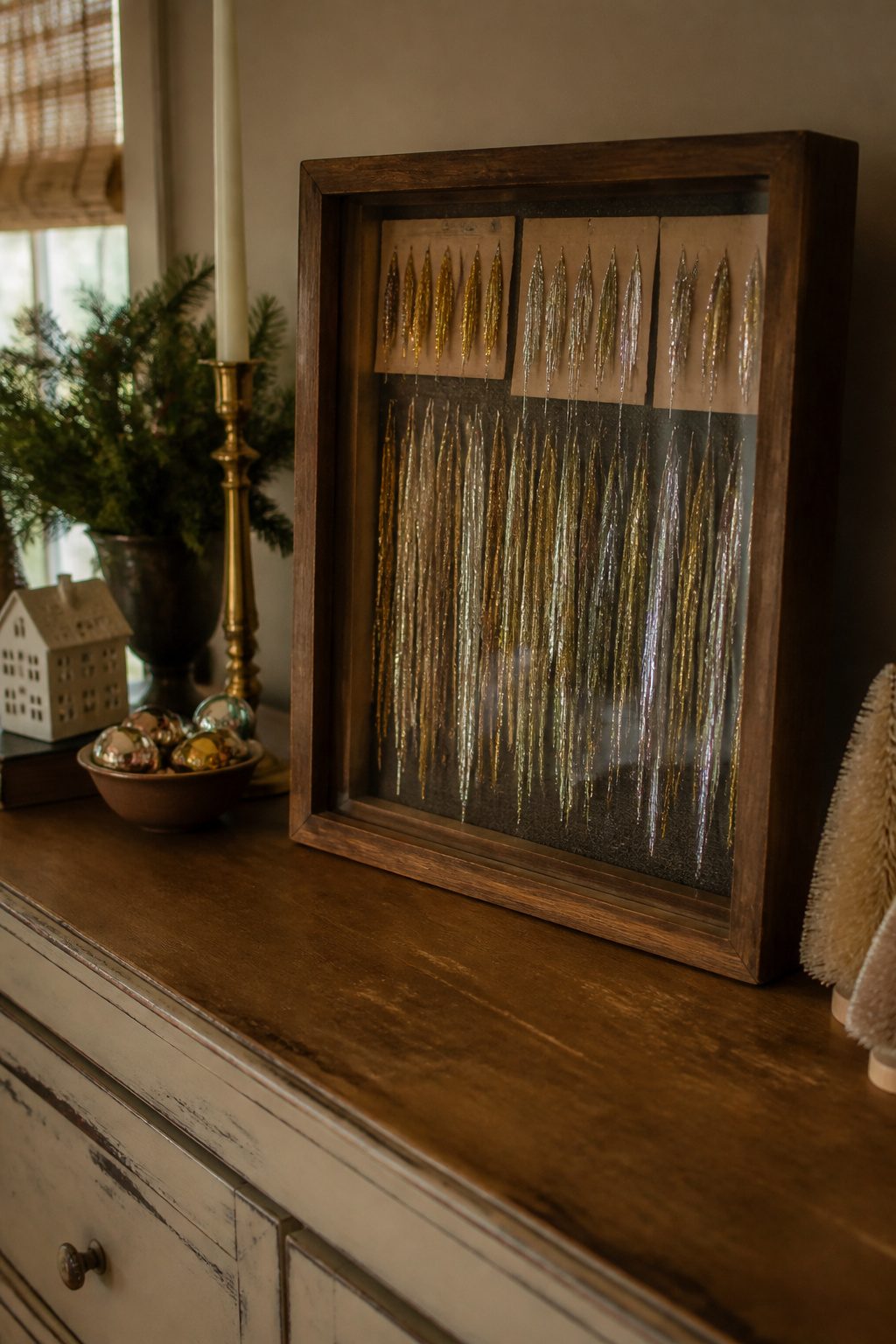
Thin metallic strands catching the light still carry that particular nostalgia for anyone who grew up with a tree that seemed to rain silver. The original vintage tinsel, though, carries something else with it: lead content and genuine fire risk that make it unsafe for household use today. The packaging alone, with its faded fonts and mid-century graphics, makes for an adorable Christmas display behind glass, but the strands themselves belong in a shadow box, not on a branch near bulbs that run warm.
Modern reproductions give the same cascading shimmer without the hazard. A tinsel-covered Christmas tree remains one of the easiest ways to impart vintage style, and the new material hangs and catches light nearly identically. If you have inherited a box of the old icicles, treat it as ephemera rather than decoration: frame a handful under glass, label intact if possible, and hang it on the wall as part of the display rather than trying to drape it where pets or children might reach.
Vintage Cookie Cutters
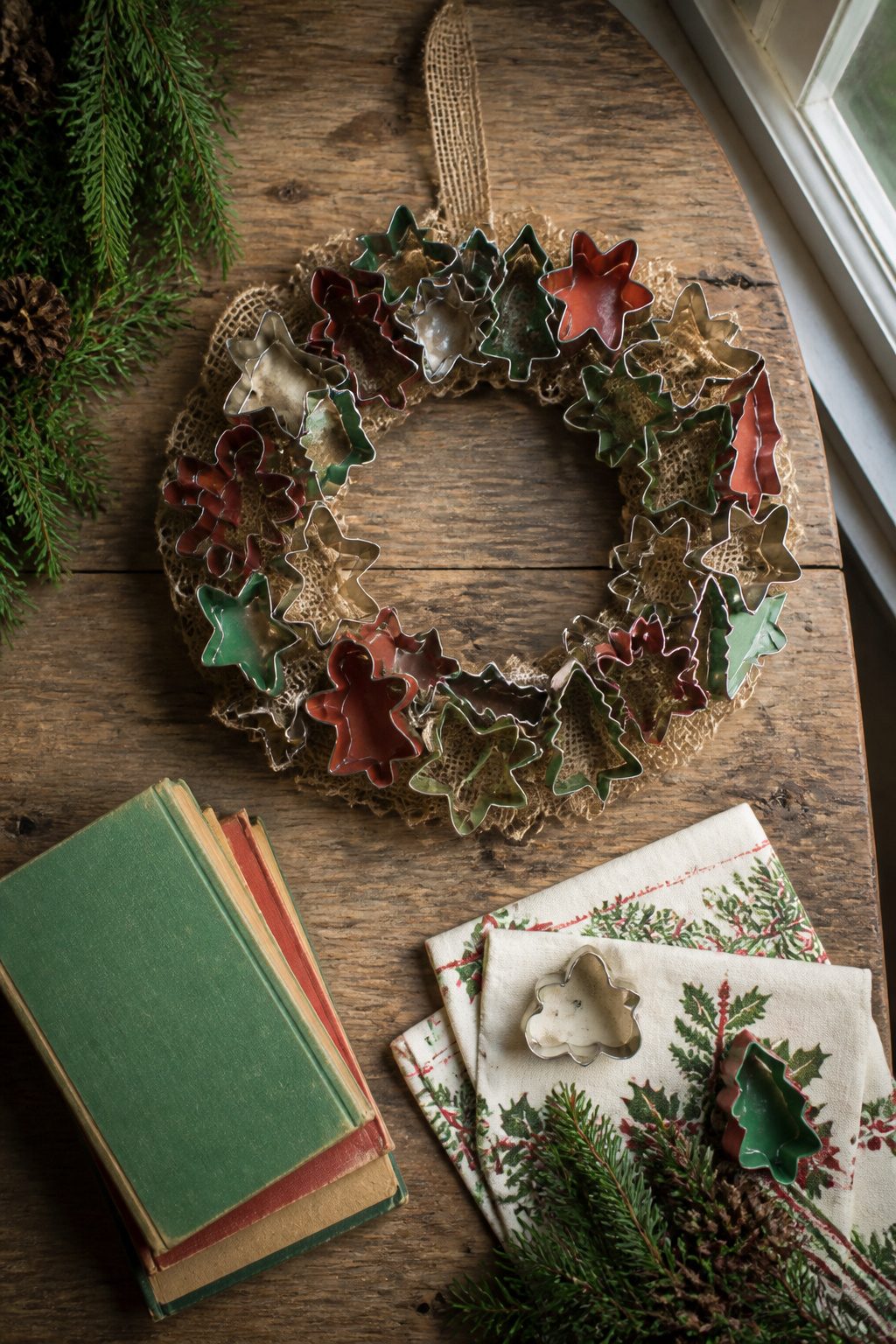
Vintage cookie cutters from the 1940s and 1950s carry shapes that mark their era: Santas with rounded bellies, candle profiles, and simple animal outlines stamped from tin. The flat backs and rolled edges of that production period sit differently against a wall than modern die-cut versions, which is why they work as display pieces rather than just bakeware.
A circular wreath built from glued cutters, tied off with jute ribbon, turns a collection into front-door decor without hiding the shapes that make each piece interesting. Shadow boxes suit the sets still in original packaging, the cardboard headers and faded illustrations becoming half the appeal on a kitchen shelf. Strung as garland, the cutters clink against each other in a way that reads as holiday sound as much as sight.
Kitchen displays extend the vintage theme naturally because the room already holds the logic of these objects. Open shelving lets the metal catch light, and the grouping reads as collected over time rather than staged. The mistake is overloading the arrangement: three or four cutters with clear space around them carry more weight than a dozen crowded together. Jute ribbon, not wire, keeps the wreath from looking like hardware-store salvage.
If the cutters are new reproductions, the same projects hold up; the visual effect depends on the arrangement, not the patina.
Vintage Holiday Glassware
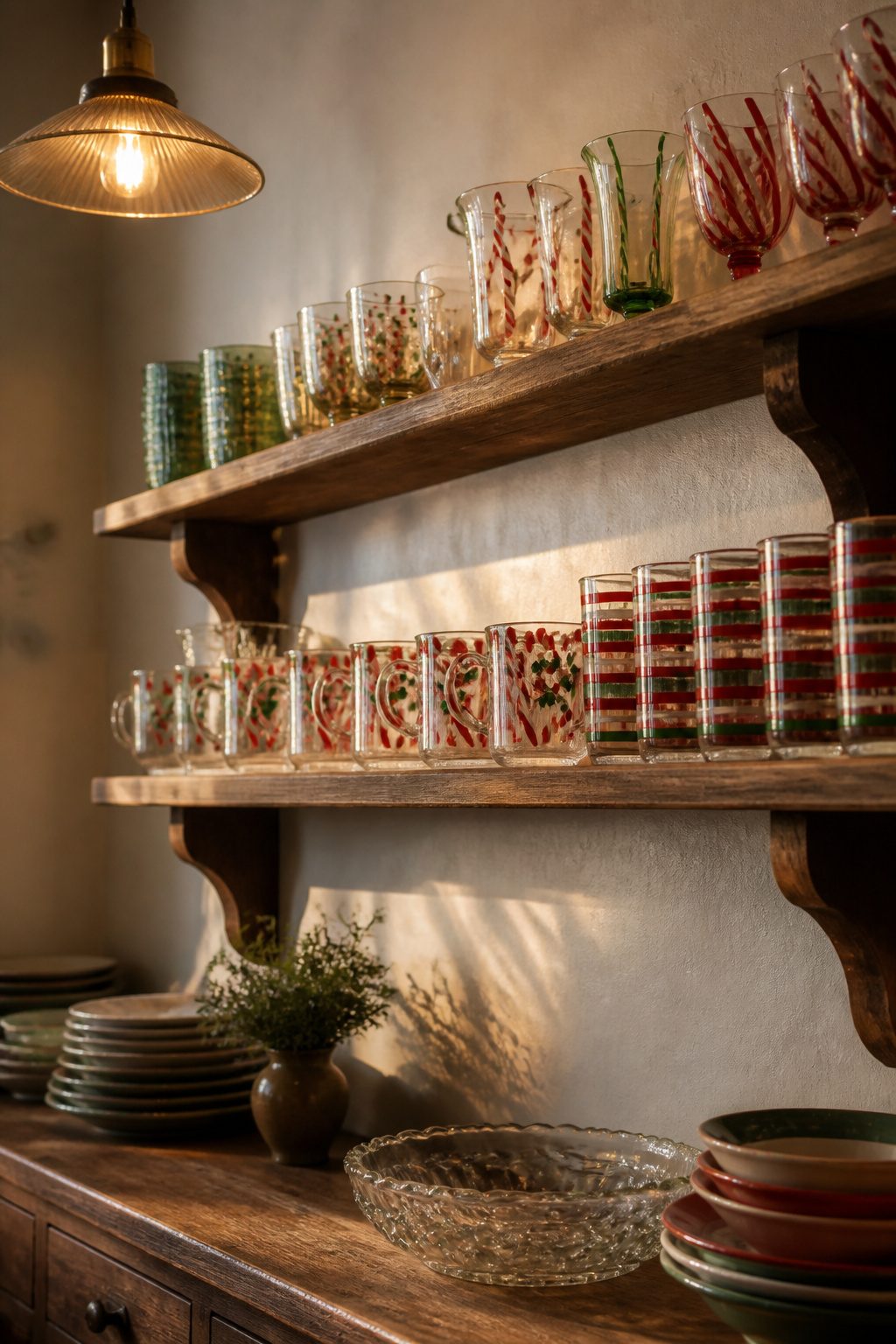
The thin-walled tumblers and punch cups that turn up at flea markets and yard sales carry holiday patterns most people walk right past. Federal Glass made candy cane–patterned milk glass mugs that stack neatly on open shelving and read as Christmas without shouting it. The same goes for their striped tumblers in red and green, or the forest-printed punch sets from the 1960s that usually sell as singles rather than full sets.
Manufacturers to watch for are Federal, Anchor Hocking, and Indiana Glass, in roughly that order of how often the holiday pieces surface. A full punch set with twelve cups still in its original wire rack is a find worth paying up for; the cups alone are common enough that paying more than a dollar or two each is a mistake I made early on.
Open shelving in the dining area extends the vintage Christmas theme without requiring a dedicated display cabinet. A single row of tumblers along a kitchen shelf, turned so the pattern faces outward, does more than a full bar cart styled for the season. The glass catches light differently from ornaments do, and the shift from living room tree to dining space feels intentional rather than scattered.
Vintage Feather Trees
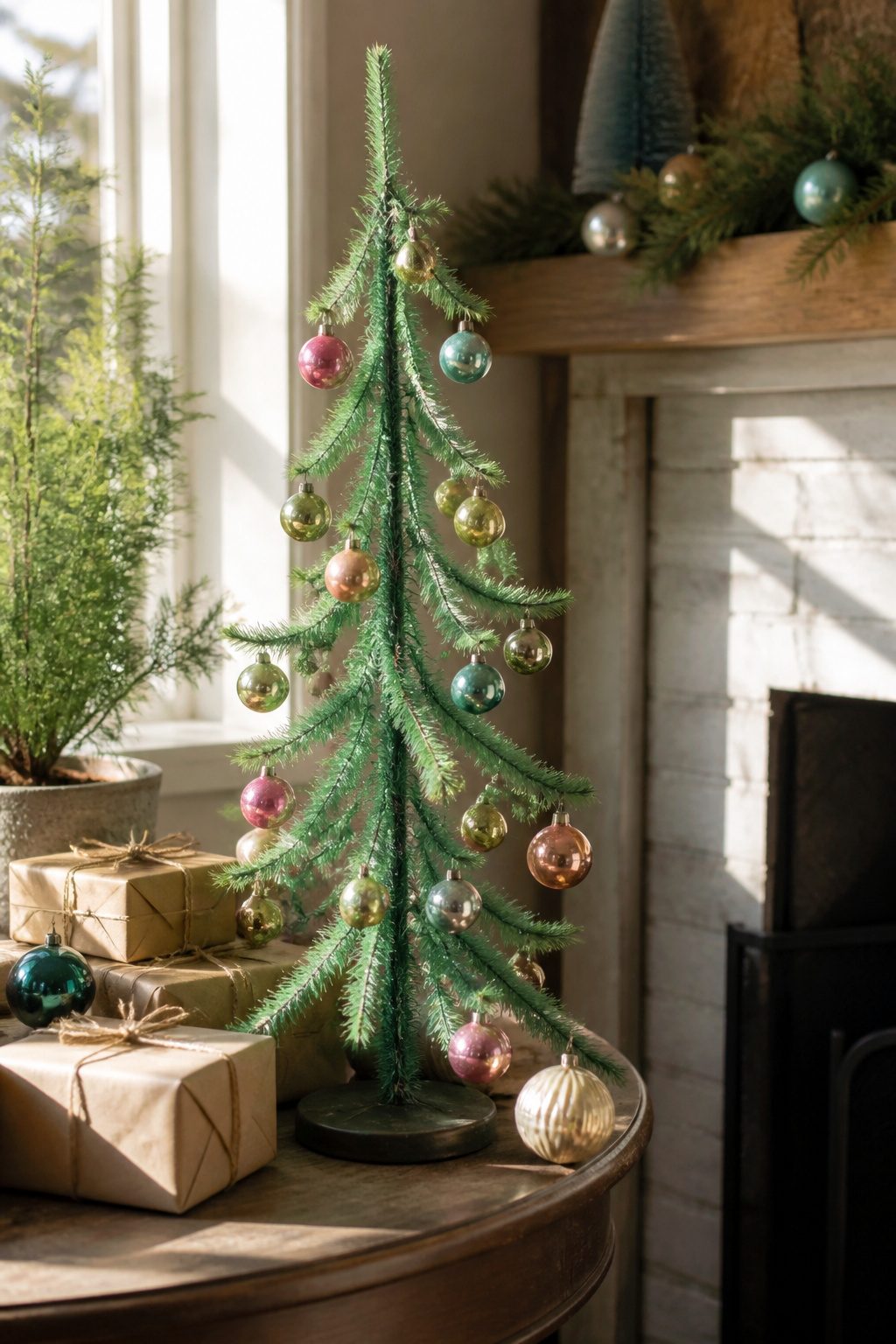
Goose feathers, dyed green and wrapped around wire, were how Germans solved the problem of Christmas trees long before plastic existed. The result is a 14-inch tabletop tree that fits on a shelf or stairwell landing without the negotiation a full-size evergreen demands in a small apartment.
The wire branch construction changes how you decorate. Each branch is a single upright spike, not the layered horizontal spray of a modern tree. Ornaments hang from the tips, not nestle into foliage, which is why the vintage ones made for these trees, Shiny-Brites and their kin, are small and light. A heavy glass ball will slide down a vertical wire; the dainty stuff stays put. Red berries wired to the branch tips, a common finishing touch on authentic pieces, give the eye something to rest on between ornaments.
I keep mine on a side table where a standard tree would block the walkway entirely. The scale is the point: it reads as a complete Christmas gesture without requiring its own corner of the room.
Vintage Foil Light Reflectors
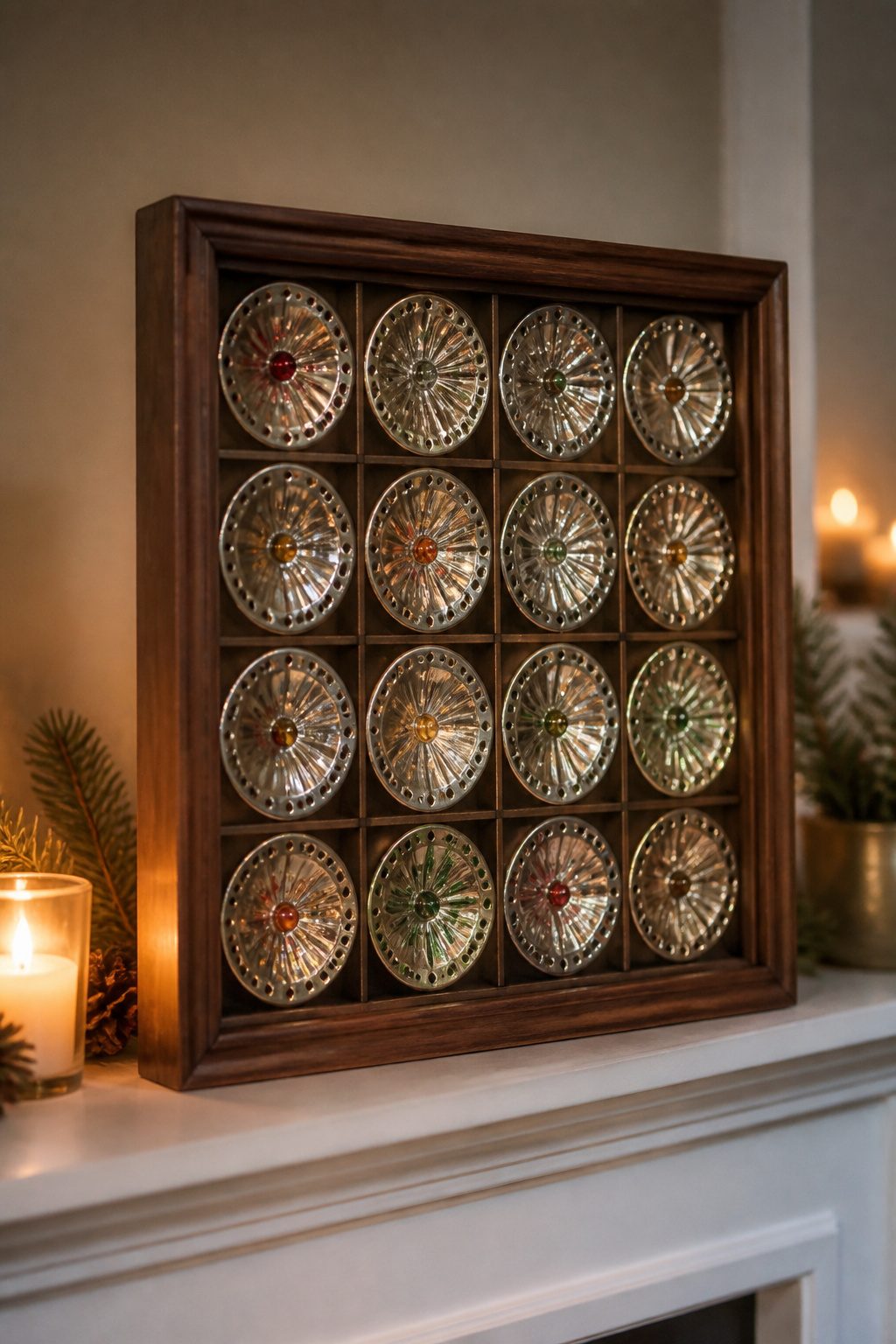
Those punched-metal disks behind 1950s candle bulbs were doing more than looking festive. The foil caught the narrow beam of each incandescent bulb and threw it back outward, so a single string of 15-watt lights read as a wall of color from across the room. The flower-shaped ones, layered in two or three tiers of petal-cut aluminum, caught the best spread.
Condition drives what you pay now, and the multilayered versions run higher. I look for sets where the pin clips still grip, since bent tabs mean hours of fiddling on the string. A full box of reflectors, even without the original bulbs, works as wall art in a grid of clip frames or pinned straight to a corkboard. Mixed into a tree display, they read as found texture against smoother glass ornaments rather than looking like a full retro reconstruction. Three or four clusters on an otherwise plain green tree do the job; more than that, and the metallic glare starts to fight the warm light instead of amplifying it.
Vintage Christmas Cards
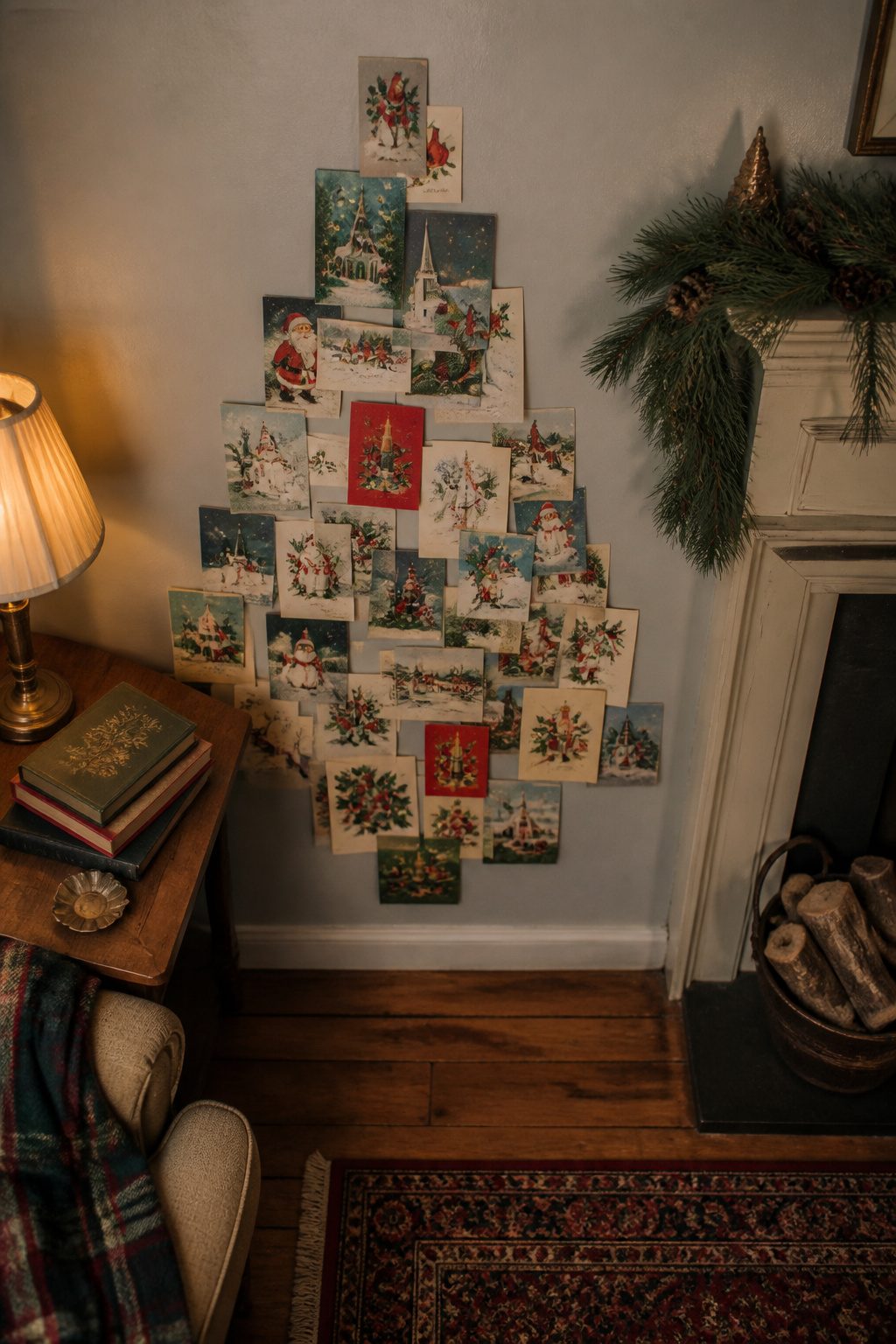
A wall of vintage Christmas cards arranged in a tree shape works in spots where a real tree won’t fit, and the graphic punch of mixed greetings layered together beats a store-bought sign every time. I found my first batch at a flea market bin for pocket change: Santas, snow scenes, midcentury typography, all of it more interesting than anything printed after about 1975. The trick is rotation. Cards this old are brittle, and light fades the reds faster than you’d think, so I keep the year’s picks in a flat archival box and swap them out before the season starts. For the single card that stops you every time, a simple frame with UV glass turns it into year-round art. The rest stay portable: tape loops on the back, pinned in a triangle from a single nail at the top, easy to take down when January arrives.
Vintage Dishware
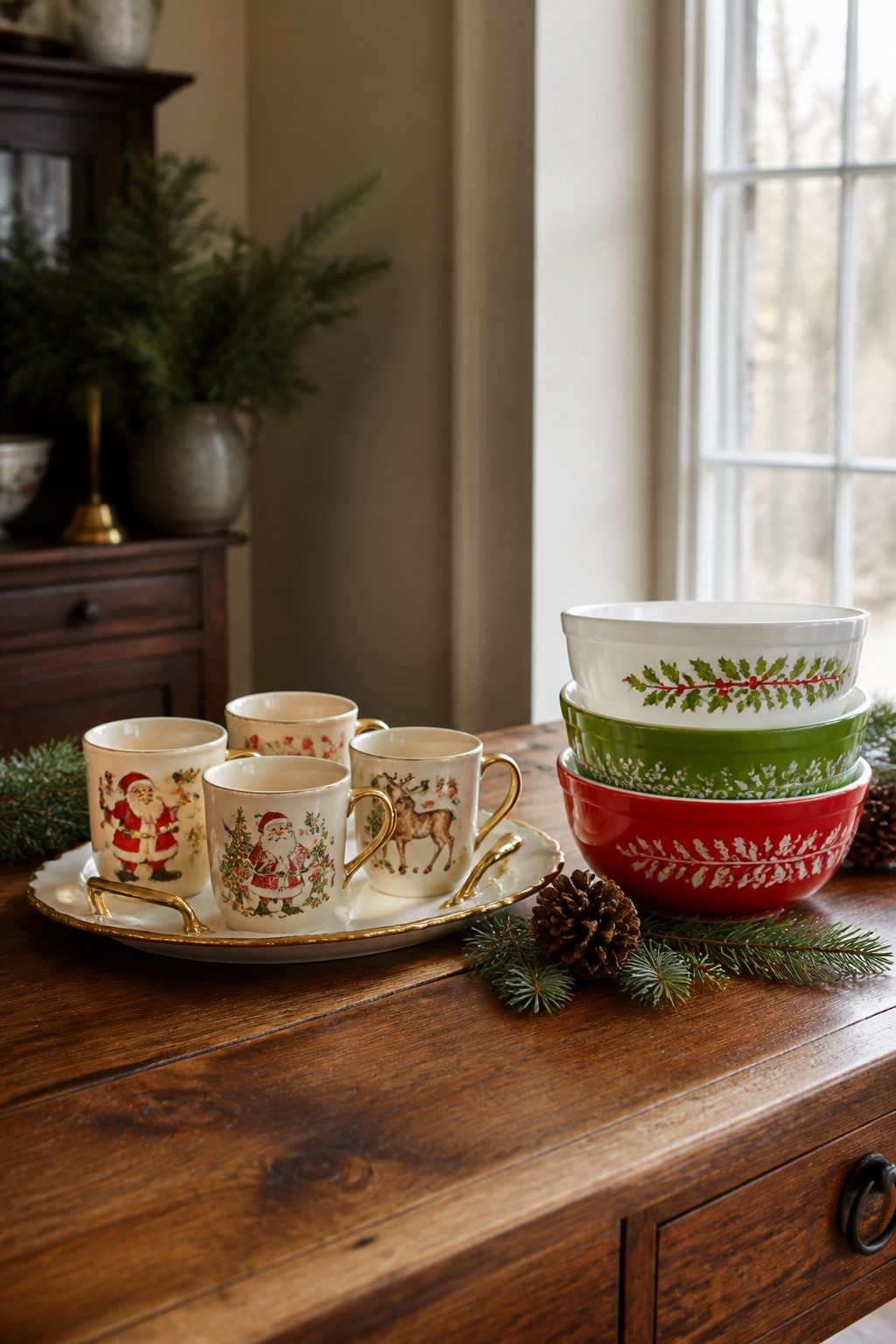
Holt Howard Christmas mugs from the 1950s and 1960s turn up at estate sales with their hand-painted faces and gold trim still intact, and Pyrex holiday bowls in the Butterprint or Snowflake patterns sit right alongside them. The fired-on designs that Hazel-Atlas and Federal Glass used for their Tom and Jerry sets and candy cane milk glass mugs were everyday production in the mid-1900s, which means the supply is deep enough that prices stay reasonable.
Open shelving or a hutch makes these pieces usable decoration through December. A stack of three Pyrex nesting bowls on a kitchen shelf reads as Christmas without demanding any extra storage. The mugs work for morning coffee, then stay on the counter as color. I keep my own holiday dishware where I can actually reach it; pieces locked in a cabinet might as well be in storage, and the point of collecting this stuff is to handle it. A hutch with glass fronts gives you the display layer while keeping dust off the painted surfaces. If the set is incomplete, that is almost better: a single Holt Howard mug on a peg hook, or two mismatched milk glass pieces flanking a small evergreen cutting, fills the space without looking like you are running a museum case.
Vintage Matchbooks and Ephemera
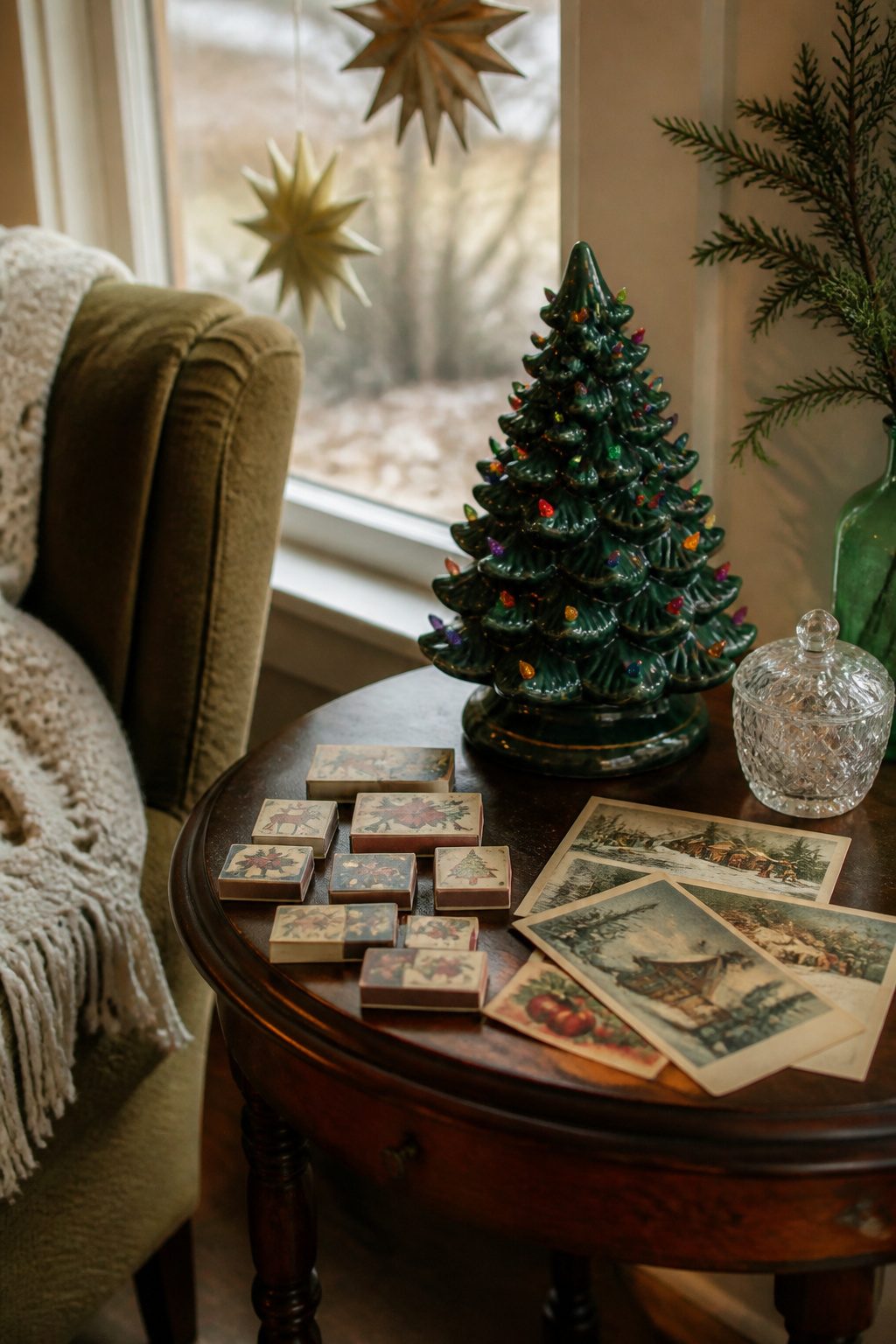
Holiday matchbooks from the mid-1900s take up almost no space, which is exactly why they work so well. A cluster of five or six tucked against a ceramic tree base or slipped under a cloche fills the dead air that makes a shelf feel half-finished. I found a set of twelve at an estate sale for under ten dollars last year, and the printed Santas on the strikers have more personality than most ornaments twice the price.
Postcards and gift tags play the same role. The small format lets you layer them where a larger piece would crowd the scene. A vintage postcard propped on a tiny easel behind a bottle-brush tree adds depth without demanding its own zone.
Paper this old needs two things: dim light and still air. Direct sun will fade those reds to pink in a single season, and handling leaves oil marks that do not lift. I keep mine in acrylic stands rather than frames, since glass traps humidity and the stands cost a couple of dollars at any craft store. For matchbooks especially, the strike strip is the fragile part; once it crumbles, the piece is just a scrap. I rotate which ones stay out, storing the rest flat in a photo box with acid-free tissue. The swap takes ten minutes and doubles the life of the collection.
Vintage Deer and Figurines
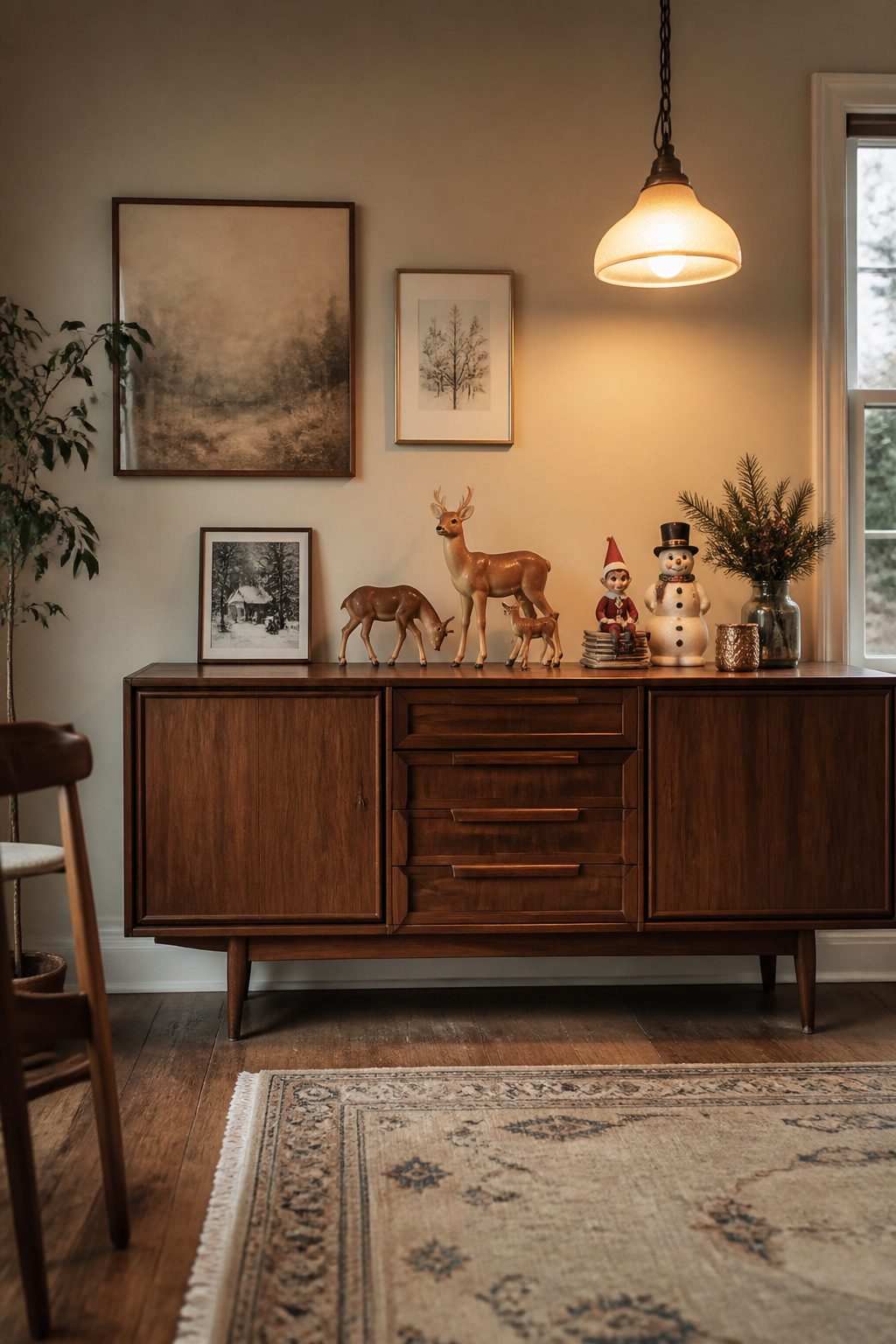
Ceramic deer from the 1950s and 1960s usually stand six to eight inches tall, small enough to cluster on a mantel without blocking the mirror above. The plastic versions run smaller, closer to four inches, and their lighter weight lets you perch them on narrow ledges or stack them on tiered cake stands. Condition issues follow the material. Ceramic legs snap at the ankles; I have three deer with glued repairs that I turn toward the wall. Plastic figures yellow in sunlight and collect dust in molded fur texture that baby wipes barely touch.
Grouping matters more than perfection. A trio of deer, one slightly larger, reads as a family and fills space without looking cluttered. Mixing one elf or a single snowman into the group breaks the matched-set feeling that catalogs too neatly. I keep damaged pieces toward the back of the arrangement and let the front-facing ones carry the scene. The scale jump between a six-inch deer and a two-inch elf works if you raise the smaller piece on a vintage thread spool or a stack of old Christmas cards.
Vintage Ceramic Trees
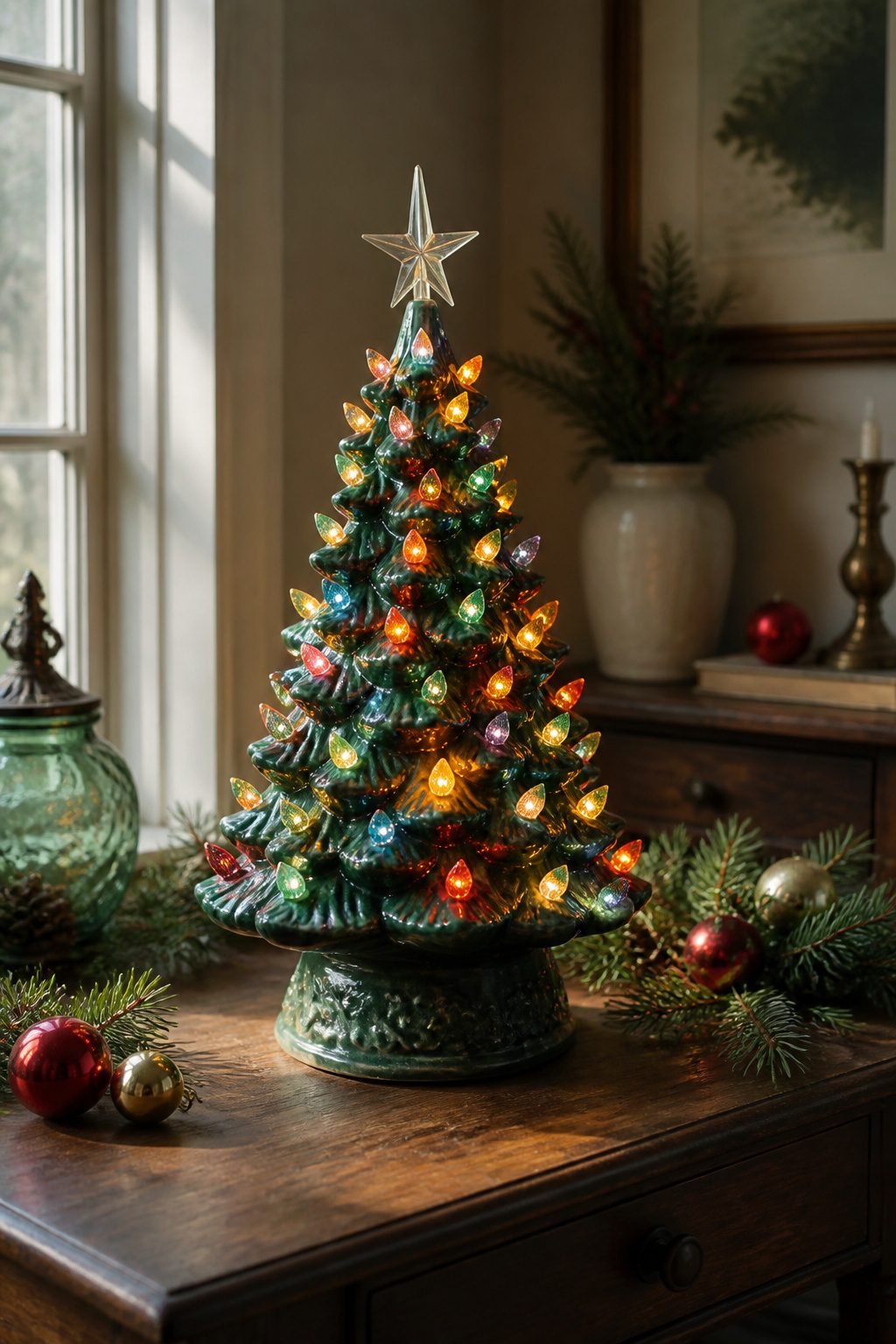
Small lighted ceramic trees with those colored plastic bulb tips sit in a strange pocket of Christmas memory, mostly produced from the 1970s through the 1980s by companies like Atlantic Mold and others. The green versions run around 18 inches and still turn up at estate sales for roughly $90 if the light cord works, while smaller light-blue LED reproductions hit about 11.5 inches and sell closer to $35. Both sizes function less as a main tree and more as a nightlight or accent piece tucked into a larger display, casting that particular amber-green glow through the ceramic holes.
The original bulb-tip trees pull more power and run warmer, which limits where you can set them safely, but that warmth is part of why they read as authentic in a mixed-era setup. The newer LED versions stay cool and travel better between apartments, though the light quality is bluer and reads more modern than nostalgic. For a renter building a vintage Christmas display on a weekend budget, one ceramic tree on a side table or kitchen shelf anchors the room without demanding the floor space or ornament collection a full-size tree requires. The cord is usually the failure point on old ones, so test before you buy and factor in a lamp-cord replacement if the seller hasn’t already.
Vintage Window Display Concepts
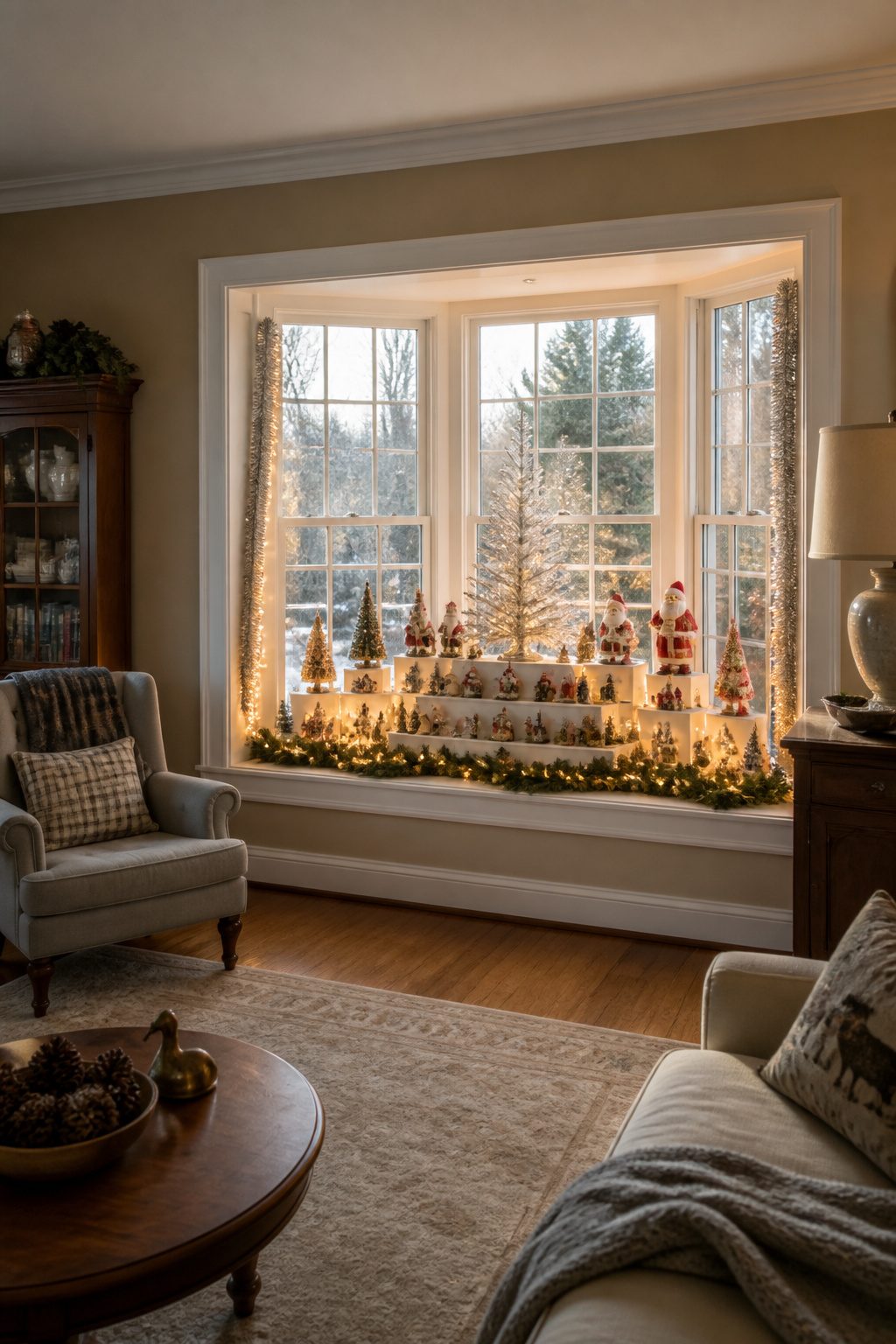
Department store Christmas windows have been pulling shoppers off the sidewalk since the 1870s, with Macy’s widely credited for popularizing the tradition in the U.S. What made those early displays work was narrative depth, not just ornament density. A 1920s window at the Emigh-Winchell Hardware Company in Sacramento layered Santa Claus up front with toy trucks, cars and bikes receding behind him, creating a scene you read like a story rather than scanned like a catalog.
That same principle scales down to a residential bay window or even a deep mantel. Sight-line planning matters more than object count: place your tallest or brightest piece at the rear center, build forward in stepped heights, and keep the front edge below eye level from the room’s main entry point. A string of lights tucked behind the rearmost objects, not draped over them, casts the forward shadows that give the scene its depth. The 1920s hardware store got this with nothing more than risers and a single overhead spot.
For renters working with a weekend and maybe a hundred dollars, foam-core platforms wrapped in brown kraft paper substitute for custom risers. The paper reads as vintage packing material and costs under ten dollars. Light it from behind with a strand of warm white LEDs on a timer, and the glow does the work after sunset that daylight does at noon. The mistake I made my first year was packing the foreground too full. Objects need breathing room to cast shadows, and shadows are what sell the depth.
Vintage Ribbons and Textiles
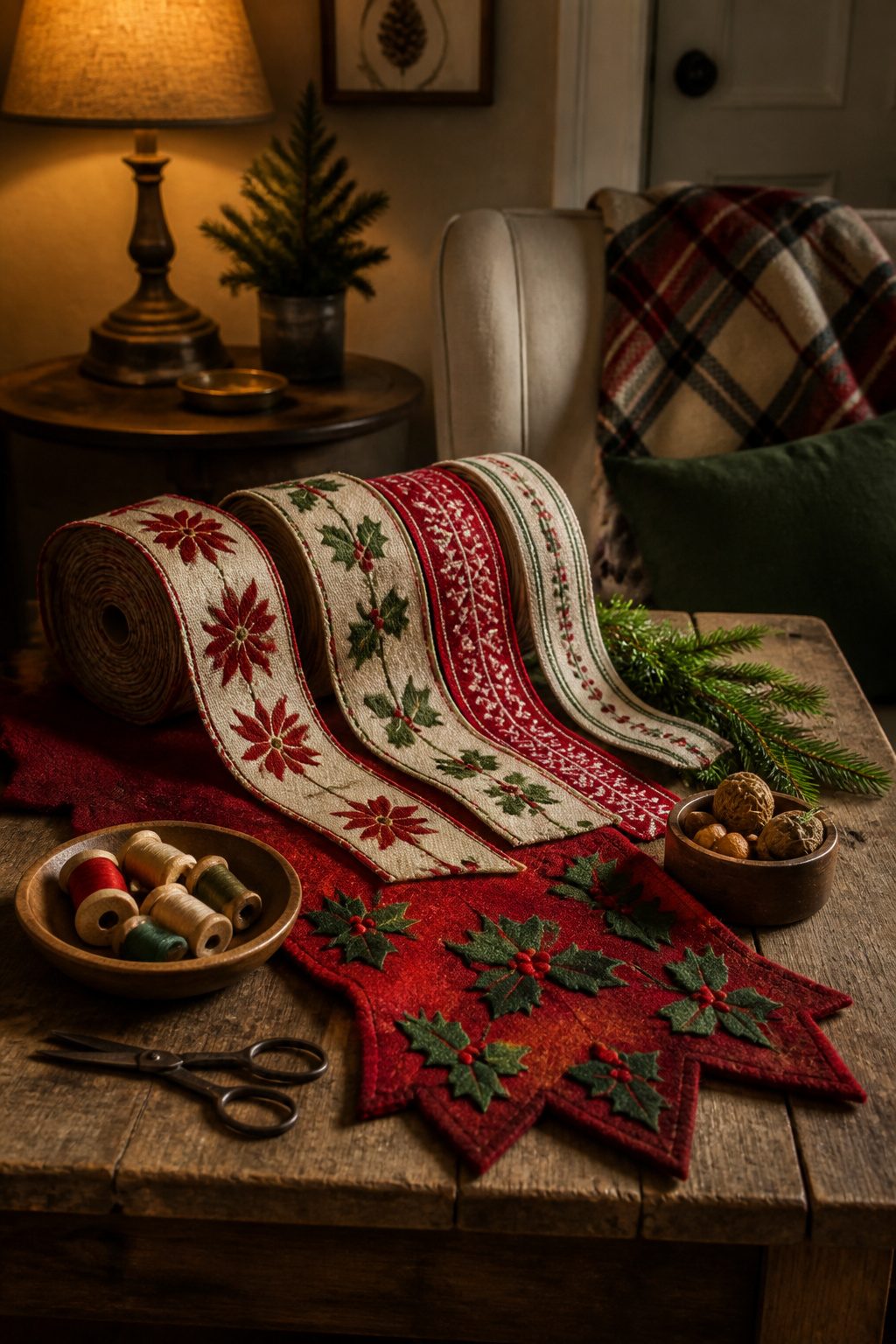
Wide printed ribbon with a striped backing runs about 4 inches across and 5 yards to the roll, enough to drape a mantel or weave through a garland without rationing every loop. The printed side shows a vintage Santa or motif, and the reverse is often plain ticking stripe, which saves the pattern from fighting itself when you tie a bow.
Felt appliqué table runners and quilted tree skirts in red, green, and white carry that same homespun weight. Most of the originals were homemade from store-bought patterns, so the reproductions and the genuine articles look nearly identical until you check the stitching. A crocheted tree skirt takes longer to find but sits flatter under the stand and softens the whole display more than a stiff skirt ever could.
These materials fray, fade, and collect dust in storage. Acid-free tissue between folds is non-negotiable, and ribbon wants to hang on a dowel or lie flat, never rolled tight enough to crease the print. I keep textiles in a cotton storage bin with a cedar block, not sealed plastic that traps humidity. The one table runner I folded and forgot in a cardboard box now has permanent shadow lines where the creases sat; the bin and the hanging dowel cost under $15 together and have outlasted three seasons of my own negligence.
Vintage Wreaths and Garlands
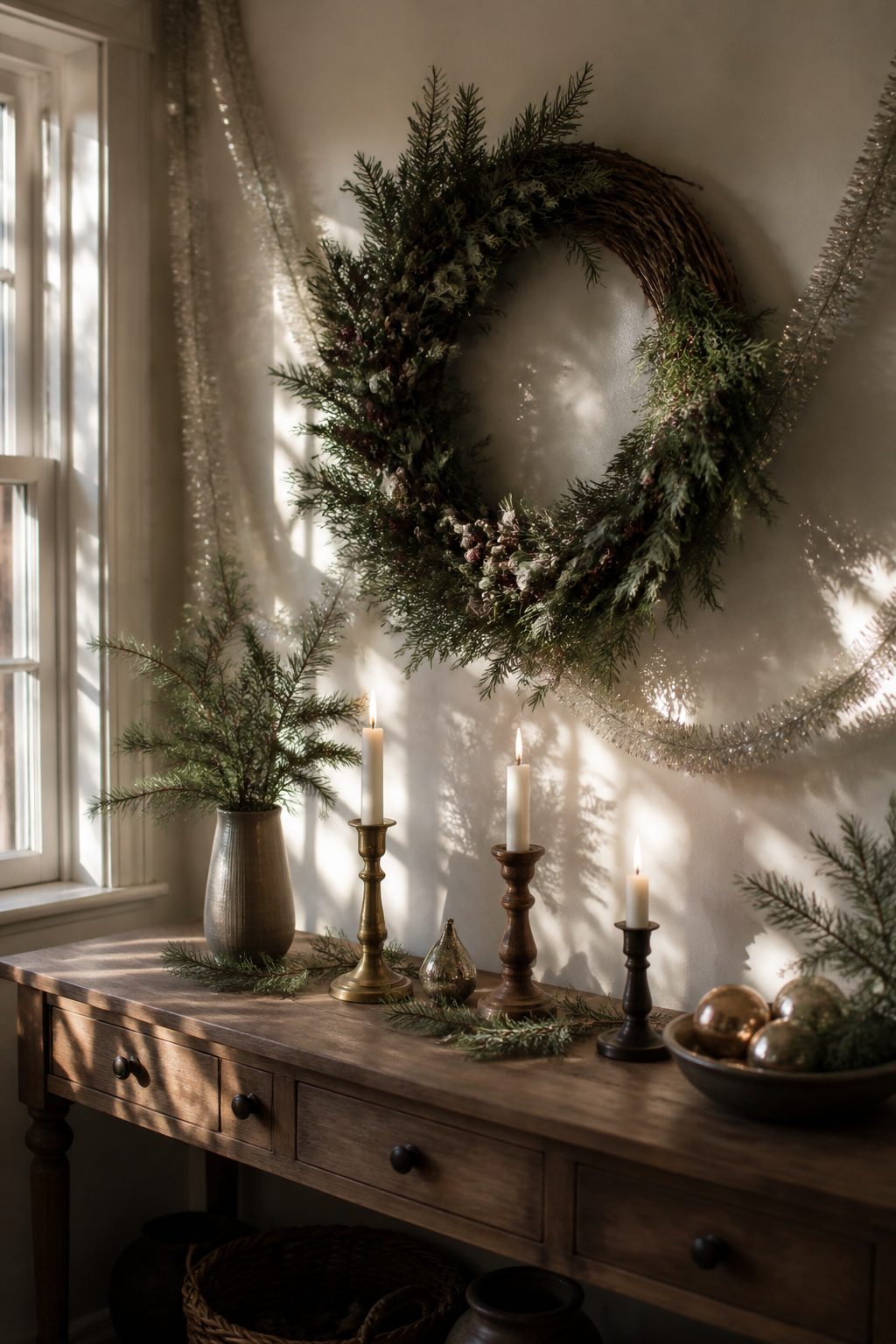
Wire frames wrapped in natural greenery age faster than the decorations hung on them, so the first thing to check is whether the base still holds its shape. A vintage wreath built on a grapevine or twig form can last decades if it was stored dry; bend the wire gently and listen for cracking. Tinsel garlands from the 1950s and 60s used lead content to get that heavy drape, which means you should wash hands after handling and keep them away from pets and small children. The strands tangle into irreversible knots if you coil them too tight, so store tinsel garlands looped over a cardboard tube, not wound into a ball.
Glass-ornament garlands need the same inspection you’d give individual baubles: tap lightly and discard any with hairline cracks, since temperature shifts in a doorway will finish the break. For worn pieces, new wire threaded through the original caps works better than glue, which yellows and fails in dry winter air. When hanging, a vintage wreath deserves a proper hook rated above its weight; adhesive strips pull paint and plaster with them, and a falling wreath scatters fragile components across a hard floor. I use picture wire looped to the frame itself, not the decorations, so the load stays on the structure that was built to carry it.
Vintage Christmas Lights
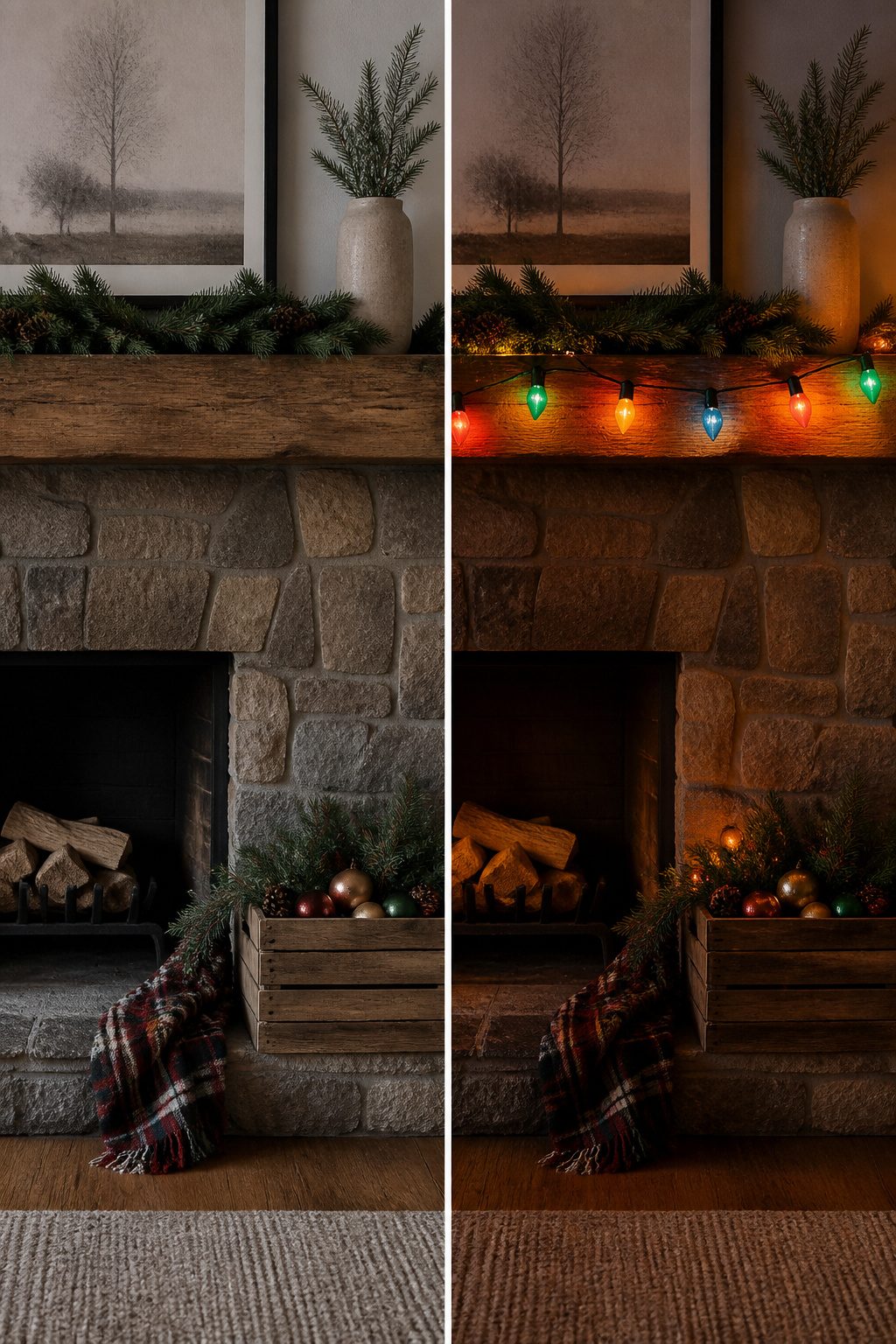
The earliest Christmas bulbs were the C6, about the size of your thumb, followed by the larger C9 that still frames ranch-house eaves in older neighborhoods. Bubble lights came later, with their low-boiling liquid that burps up through a glass tube, and they remain the most collected of the three. Original wiring from before the 1980s should never be plugged in as-is; cloth insulation and brass sockets can crack or arc, and replacement cords are cheap insurance. I rewire my finds with modern lamp cord, keeping the vintage sockets if the shells are sound, or I buy reproduction bubble lights that run on LED and skip the heat entirely. The reproductions lack the slight delay of real methylene chloride warming up, but they also won’t scorch a paper garland or trip a breaker in a 1920s rental with ungrounded outlets. For display, vintage strings work best where the cord stays visible, draped along a mantel or wound through a ceramic tree, since the bulbs themselves read as period detail even when the wire behind them is new.
Vintage Stockings and Textile Hangings
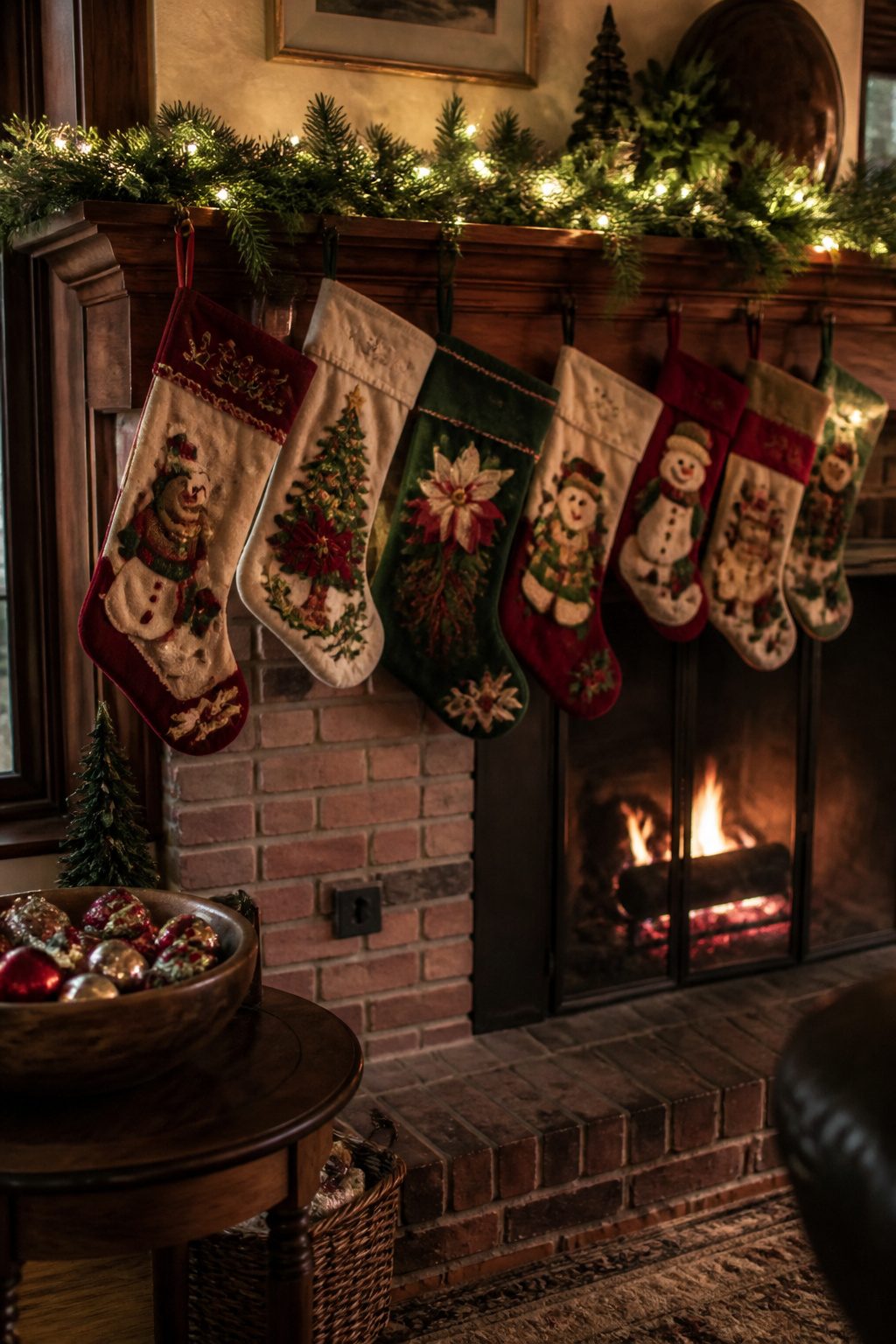
Needlepoint stockings with their thick wool stitches, felt appliqué Santas, and sequined snowflakes from the 1950s and 60s carry a weight that printed fabric never matches. The sequins catch firelight in a way that reads as magic rather than glitz, which is why I hang mine where a lamp will hit them in late afternoon. Mantels work best if you stagger heights: a tall stocking hook at the left end, a shorter one right of center, so the eye travels rather than flattening into a row. Staircase banisters need more care; the stocking cuff wants support from a wide ribbon loop, not a tight wire that creases the fabric over a month.
Light damage is the quiet killer here. Felt fades to a dusty version of itself, and sequined threads dry out and snap. UV-filtering glass in a deep frame lets you hang a particularly fragile piece on the wall as art, away from direct sun but still in the room’s sightlines. For active use on the mantel, I rotate: three weeks displayed, the rest of the year in a cotton pillowcase in a closet that doesn’t get attic-hot. The pillowcase matters. Plastic bins trap humidity; cotton breathes. I learned that after a felt reindeer’s nose went slightly stiff in a sealed container one August.
Vintage Centerpieces and Tableware
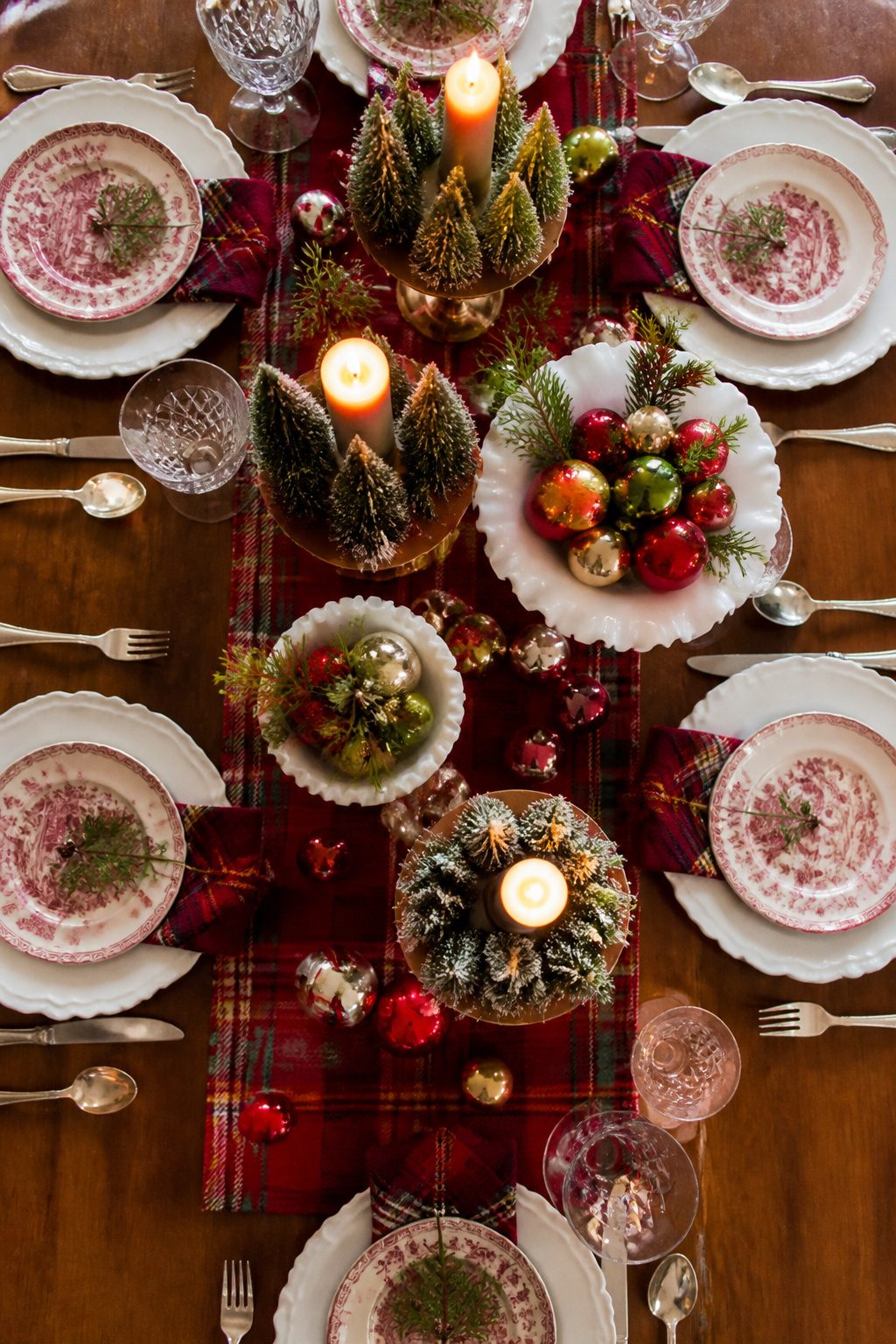
A dining table already holds plates and glasses, so the vintage layer needs to work around daily function rather than fight it. Candle rings built from bottle brush trees and paper snowflakes sit low enough that conversation still flows across the surface. I cluster three at graduated heights, one on a turned-wood candlestick I found at a church rummage sale, the others on stacked tart tins. The compotes matter more than the trees themselves; milk glass or pressed amber catches the light and reads as collected rather than bought-as-a-set.
Place-setting accents are where I stop myself. One small element per chair is enough: a single Shiny-Brite wired to a napkin, or a postcard tucked under the plate rim with the year penciled on the back. More than that, and the table becomes a display you eat around instead of at. I learned that the hard way after a dinner where guests kept knocking over a row of ceramic Santas I thought looked charming.
The table anchors the room’s second display zone, separate from whatever happens on the mantel or in the window. Keeping it lower and quieter lets the eye rest, and it means cleanup between meals takes two minutes, not twenty.
Vintage Ornament Varieties Beyond Shiny-Brite
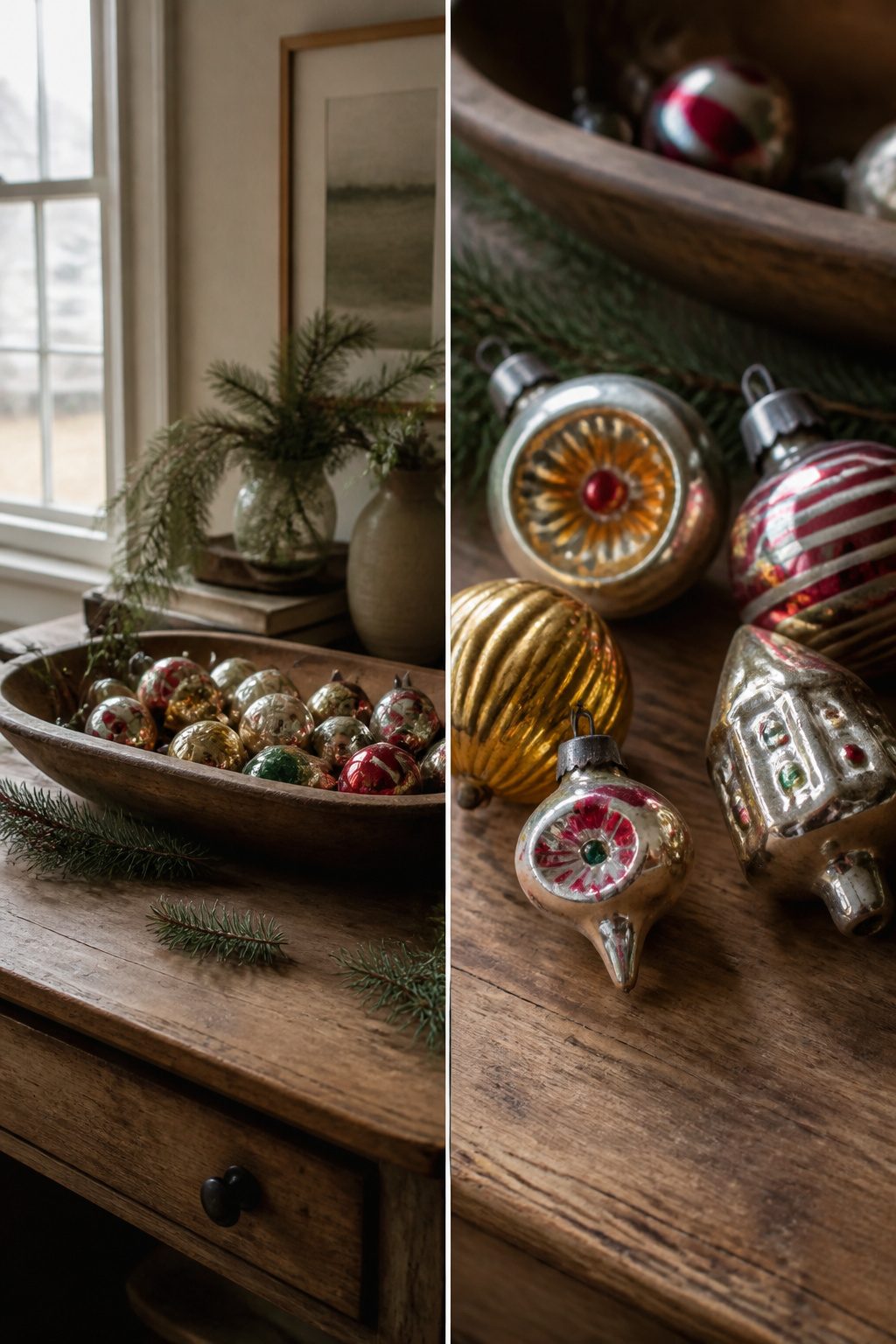
Glass figurals, the ones shaped like Santas and snowmen and tiny cottages, carry more weight in a display than their size suggests. I learned that the hard way after filling a bowl with mixed-era baubles and watching the whole arrangement read as garage-sale random. The fix was grouping by form: a cluster of German figural clips, those wire-hinged ornaments that actually grip the branch, against a few American-made indented reflectors with their concave mercury-glass dimples. The contrast in surface alone, matte painted plaster against mirror-bright indentations, gives the eye somewhere to rest.
Condition grading matters more with these older pieces than with Shiny-Brites. A figural clip missing its spring still clips, but it hangs crooked; an indented reflector with a crack in the silvering throws back a distorted face that ruins the nostalgic effect. I pass on any reflector with more than 20 percent of its backing gone, and I note the maker when I can find it. West Germany, Poland, Japan, and early American studios each used slightly different glass weights and paint palettes. Mixing them deliberately, two Polish indentations against a heavier German Santa, builds depth that same-country sets never achieve. The labels fade, so I photograph any paper tag before it disappears into storage.
Vintage Collectibles and Display Strategy
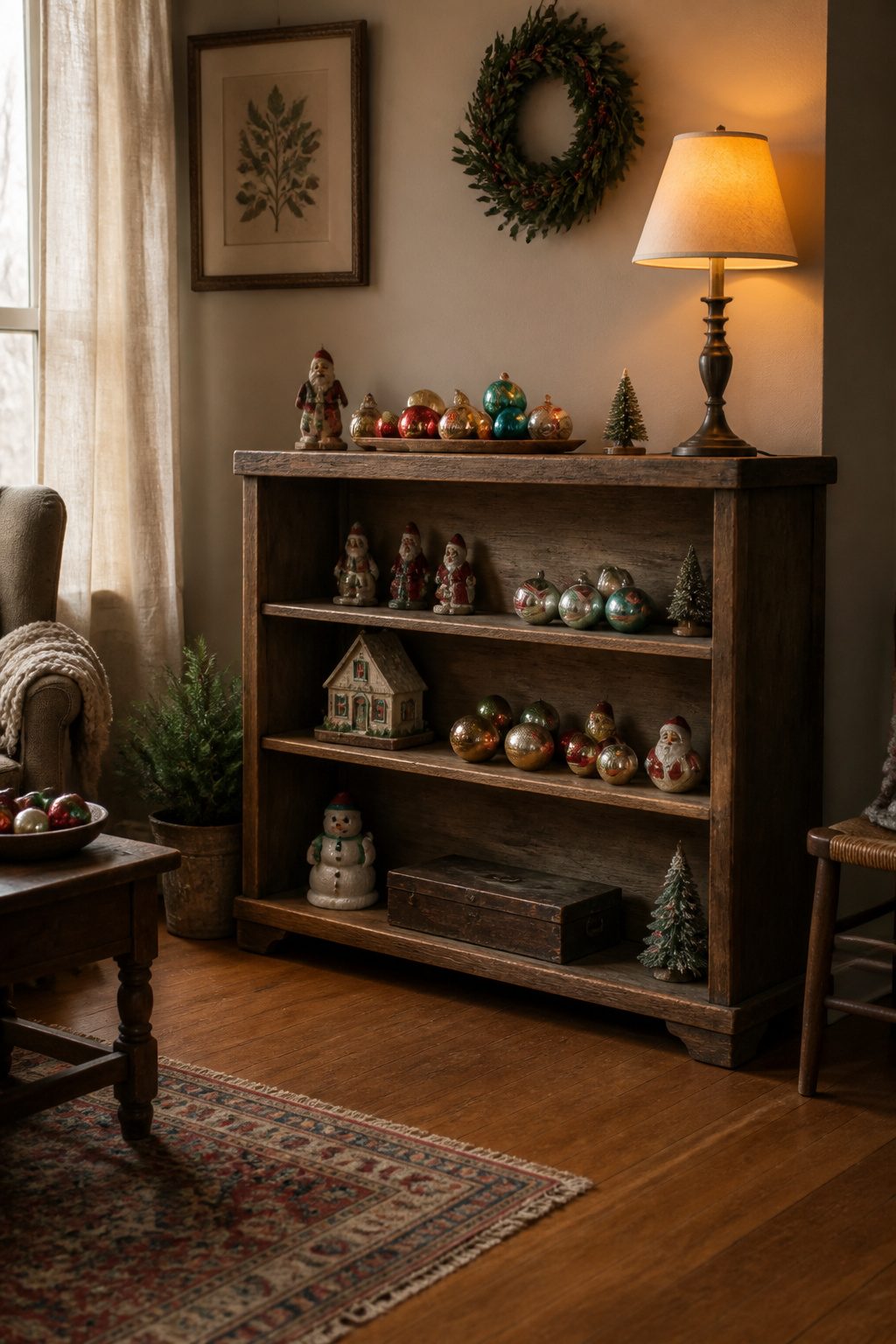
A shelf full of vintage Christmas finds quickly turns into visual noise if every piece fights for attention at once. The rule of odd numbers helps: three Shiny-Brite ornaments on a stand read as one intentional cluster, while four scatter the eye. I learned rotation the hard way after unpacking every box I owned the first December in my apartment. The mantel looked like a shop window that had tipped over. Now I keep about sixty percent out and store the rest, swapping pieces around New Year’s when the post-holiday lull hits. Sight lines matter more than density. A single tall bottle brush tree at the back of a shelf, with a small deer figurine and a stack of aged matchbooks stepped down in front, gives the eye a path to follow. Leave six inches of bare surface between groupings so each collection registers as its own moment. The emptiness is doing work, not wasting space. For renters working with standard 10-inch shelves, that usually means one grouping per two-foot span, maybe two if one is low and horizontal.
Sourcing from Estate Sales and Markets
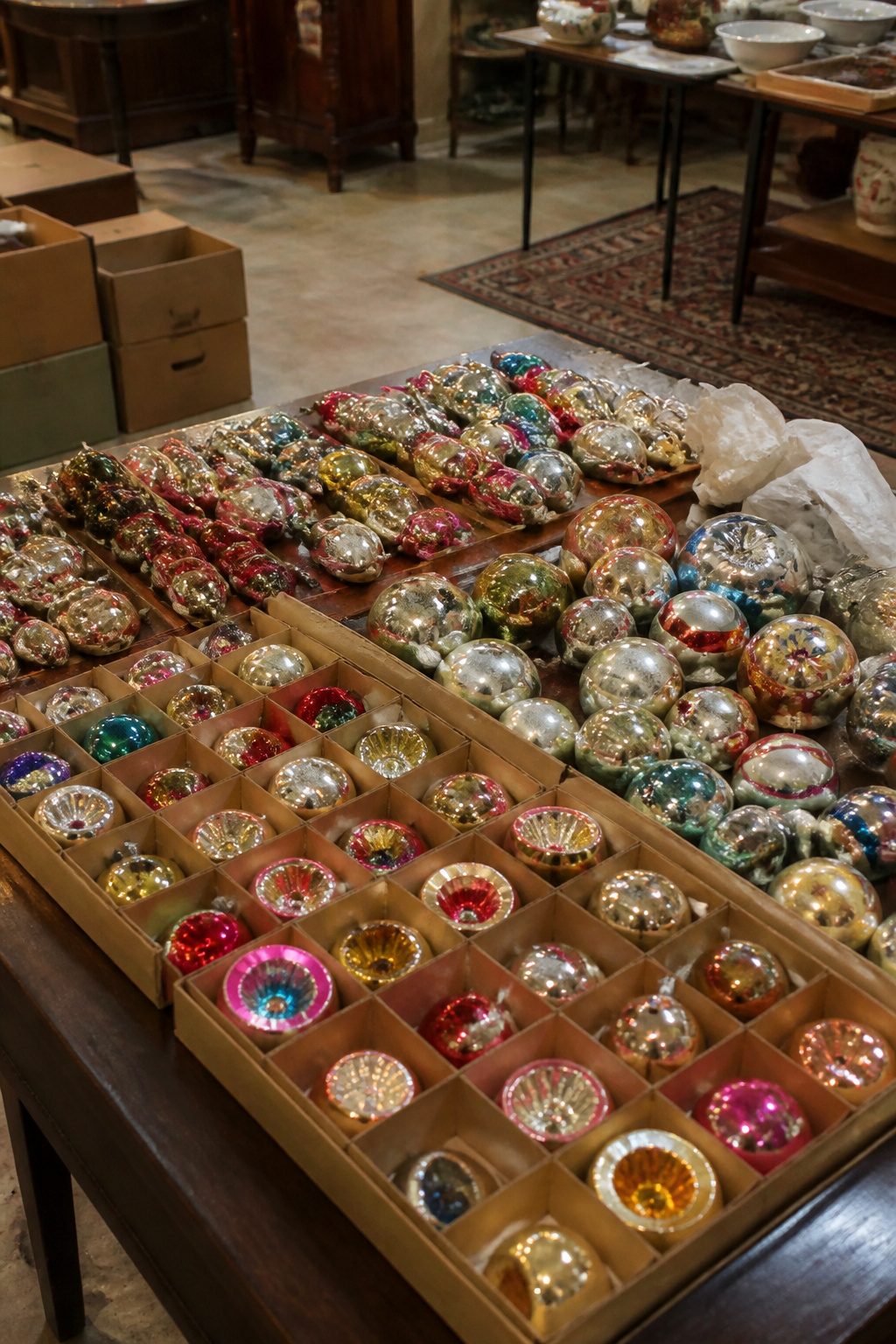
Estate sales reward the early arrival, though the first hour often brings dealer markups that soften by Sunday afternoon. I have found the real value in the last two hours, when boxed lots of ornaments sell for what a single Shiny-Brite would have cost at opening. Condition matters more than age with vintage foil light reflectors; multilayered versions run higher, but a single torn petal drops the price to bargaining territory. Carry small bubble-wrap sleeves and a rigid photo-mailer box so layered reflectors or glassware do not flatten in your bag.
Flea markets and antique shops spread the same inventory across very different pricing. Yard-sale glassware with holiday motifs turns up for a few dollars per piece, while matched sets of Federal Glass candy cane mugs in shops or on Etsy command a premium. The same Federal Glass mugs, mismatched, often hide in barn-sale bins year-round. I check for hairline cracks in milk glass by tilting toward the light, and I never negotiate before handling the piece; sellers read eagerness. For transport, a layer of tissue between each mug, then a towel wrap inside a hard-sided cooler, has saved more than one drive home.
Nostalgia and Memory in Display Choices
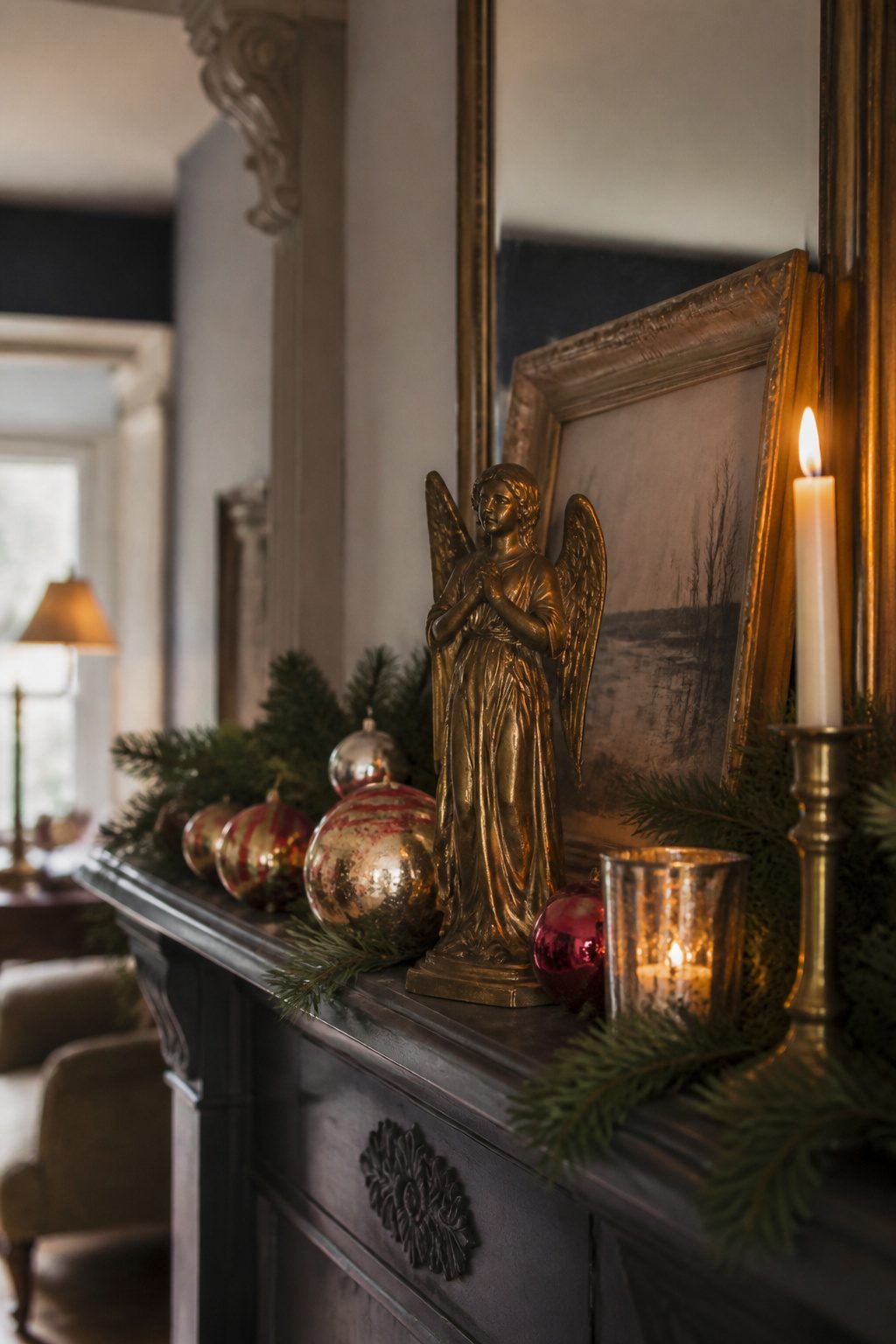
The brass angel my grandmother hung every year sits on my mantel now, and the hook on its halo still carries the faint bend from her wire ornament hanger. That damage is part of why I keep it. Inherited pieces carry memory best when they still show the life they lived through, not when they have been restored to a generic shine.
Not everything pulled from a relative’s attic earns a place. I once kept a box of glass icicles for two seasons before admitting they sparked nothing in me except guilt. The test I use now: if I can tell the story of where it came from and who hung it, it stays. If the story is only "it was there," it goes to a shop where someone else’s memory might catch on it.
Cultural memory works the same way. A 1950s aluminum tree carries mid-century American optimism whether your family owned one or not, but it displays better when you know why the color wheel mattered, or why some families kept theirs in the closet for decades after the trend passed. The resonance is the display. Without it, vintage Christmas becomes staging, and staging reads cold from across the room.
Creating a Vintage Window Display
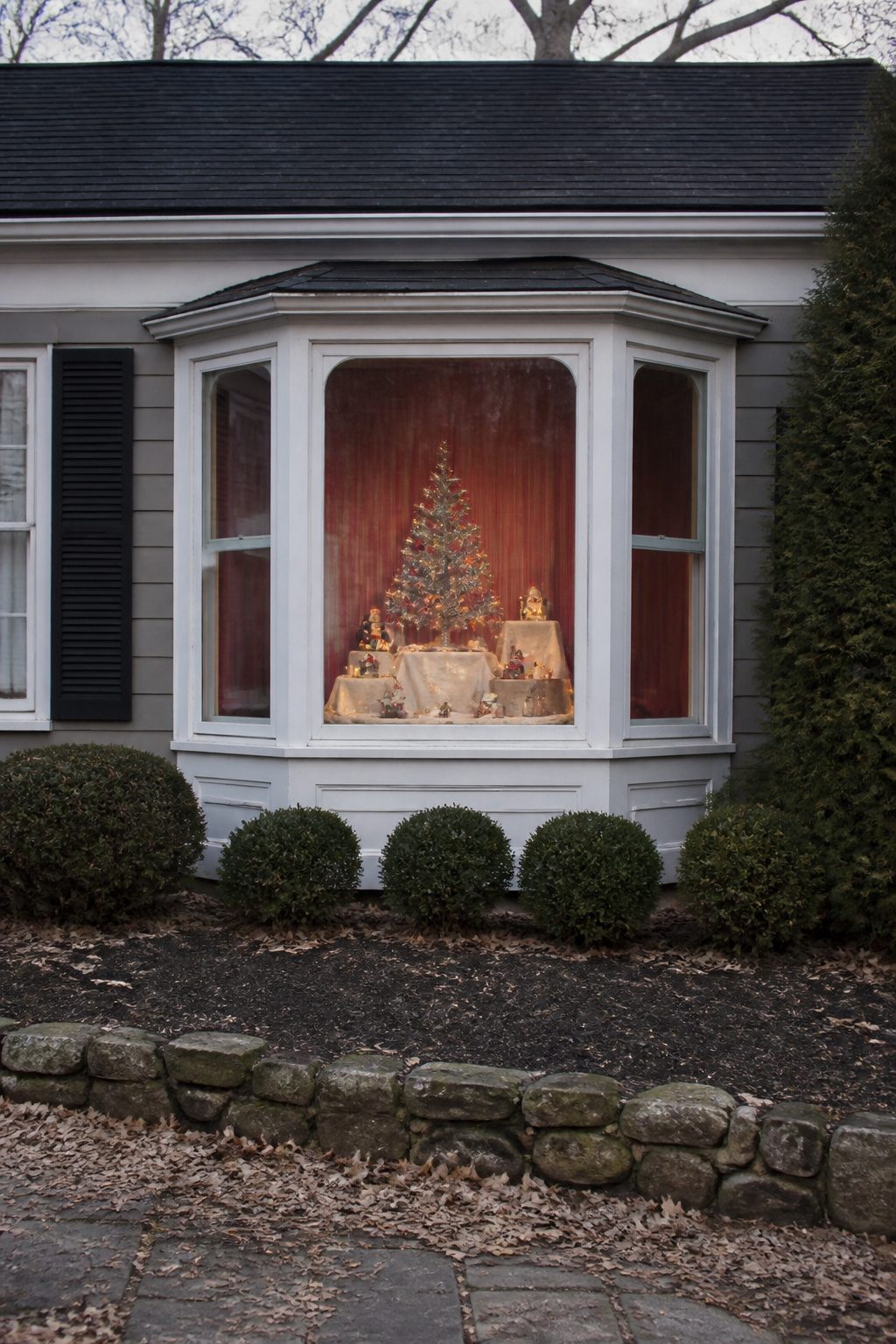
Store windows taught me that elevation is what separates a pile of objects from a scene worth looking at twice. A vintage display at home needs the same lift, but without the commercial budget. I use stacked apple crates covered in unbleached muslin for risers; the fabric hides the gaps and the wood adds warmth that plywood lacks. Backdrops matter more than the objects themselves in some ways. A length of faded red ticking stripe, hung with simple clips, reads as old wallpaper without the commitment of paste. For lighting, skip the colored bulbs that turn everything purple. A single warm white spotlight from above, even a clip-on desk lamp aimed at the ceiling first so the light bounces down, gives that amber glow people associate with memory. Sight lines from the street mean keeping the tallest piece below the curtain rod and clustering toward the center third of the window; from inside a room, the same rule applies but reversed, with the display facing the entry door so it catches you walking in. The mistake I keep making is crowding too many eras together. A 1950s aluminum tree fights with Victorian ephemera. Two decades, mixed textures, one color story: that is the limit before it reads as a flea market stall.
DIY Vintage-Inspired Projects
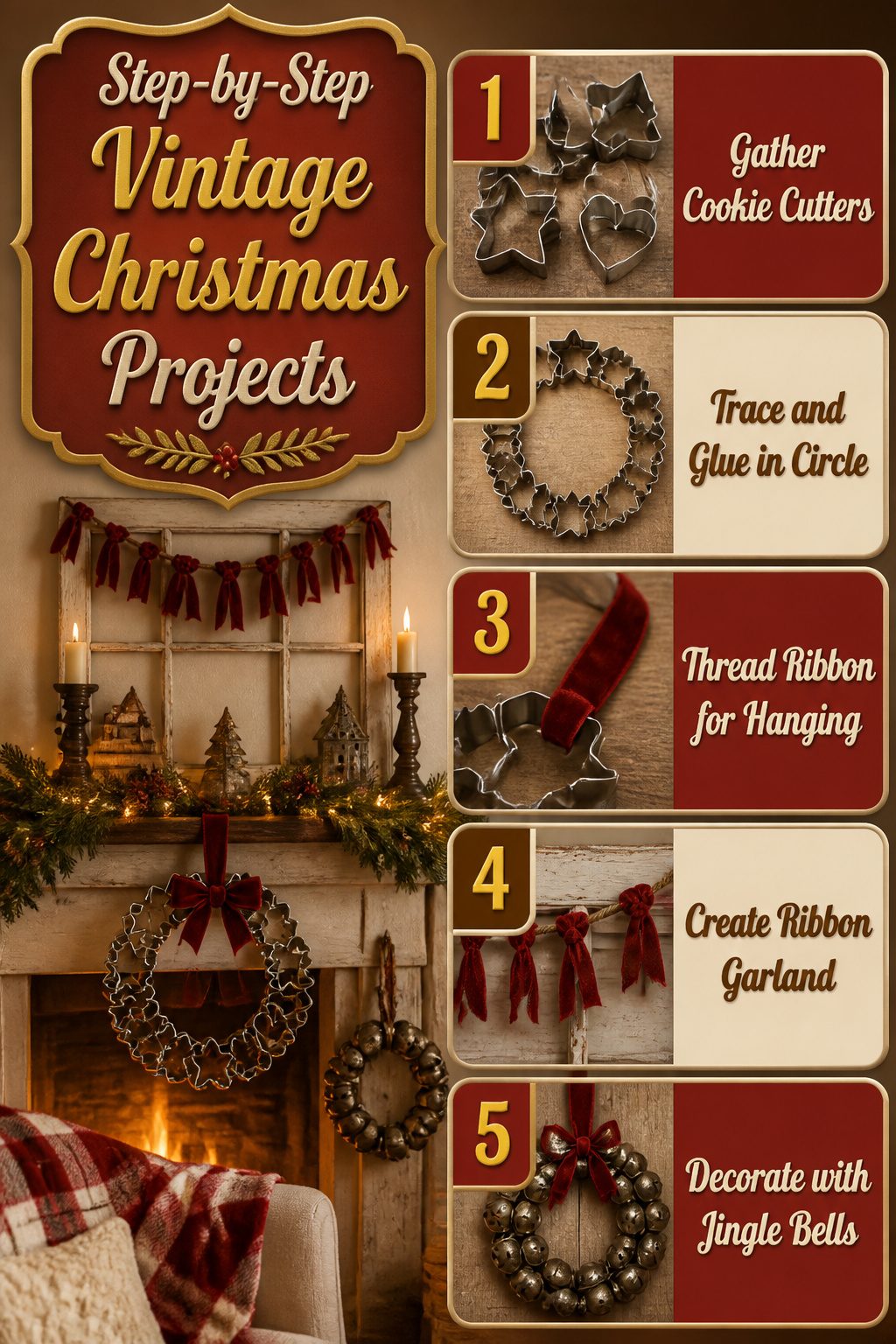
A wreath built from cookie cutters solves the problem of wanting vintage presence without the hunt. The shape is traced by gluing cutters in a ring, any ribbon threaded through for hanging. Jute reads country; velvet ribbon stems run about $11 if you want richer color against metal. New cutters work the same as old, so the project stays under a few dollars if you already own a set.
Ribbon garlands stretch the same idea across a mantel or window frame. Red velvet cut into strips and knotted along twine gives weight and shine that paper lacks. A mounted window frame, garland draped along its top rail, becomes instant architecture in a rental where nails are scarce; the frame leans or hangs and the garland does the seasonal work.
The jingle bell wreath pairs well there, too. Metal on metal keeps the palette narrow, which is what makes a thrown-together collection read as intentional rather than yard-sale random. Two materials, one era of finish, and the eye rests.
Pricing and Value for Collectors

Dresden ornaments run anywhere from $5 to $100, and that spread tells you everything about how vintage Christmas collecting works. Embossed cardboard pieces with more intricate designs or sharper condition command the top end, while simpler examples with softened edges or faded paint sit at the bottom. Foil light reflectors follow a similar pattern: multilayered versions in good shape pull higher prices than single-layer ones with dents or tarnish.
Condition, rarity, and maker marks all move the needle, but not equally for everyone. A collector buying for investment chases mint pieces with documented provenance. Someone building a vintage Christmas display can afford to be looser. Slight wear on a Dresden animal that still reads clearly from three feet back is displayable; the same wear destroys resale value. The reflectors that clip onto your tree lights work the same way. A little oxidation on the back matters less than whether they still catch and throw light the way they were meant to.
My own preference runs toward pieces that photograph well and survive handling. A pristine ornament I am afraid to hang defeats the purpose. The money goes further when you buy character over perfection, and the tree looks warmer for it.
Frequently Asked Questions
What are some vintage Christmas decoration ideas?
Painted glass Shiny-Brite ornaments from the 1930s through the 1960s, brightly colored cardboard Putz houses arranged in village scenes, and small aluminum Christmas trees with spinning color wheels all make strong vintage Christmas displays. The article also covers feather trees, ceramic trees with plastic bulb tips, foil light reflectors, and arrangements of vintage Christmas cards in tree shapes. Each piece works best with intentional placement: tiered bowls for ornaments, staggered depths for Putz villages, and bare branches for aluminum trees to let the color wheel light do the work.
Where can I find vintage Christmas decorations?
Estate sales, flea markets, and yard sales are the most reliable sources for authentic vintage Christmas pieces at reasonable prices. The article mentions finding Shiny-Brite ornaments and aluminum trees at estate sales and flea markets, Putz houses at estate sales, and holiday glassware at flea markets and yard sales. Shopping year-round at these venues beats the inflated prices and picked-over selection of December antique shops.
What is the value of vintage Christmas decorations?
Value varies sharply by condition, working parts, and rarity. A working vintage color wheel for an aluminum tree costs more than the tree itself, while individual holiday tumblers from Federal or Anchor Hocking should run only a dollar or two each. Original ceramic trees with working cords sell around $90 at estate sales, and leaded vintage tinsel carries value only as display ephemera behind glass, not as usable decoration. Condition flaws like flaking mica on ornaments or cracked bases on figurines drop display value faster than price alone suggests.